
Commercial Flat Roof Repair vs Replacement: How the Decision Is Made
The evidence that decides commercial roof repair vs replacement, why moisture usually settles it, and what to have in hand before you choose. The commercial roof repair vs replacement question often arrives framed around age. The roof is eighteen years old, somebody quoted a replacement, and the owner wants to know whether it is time.
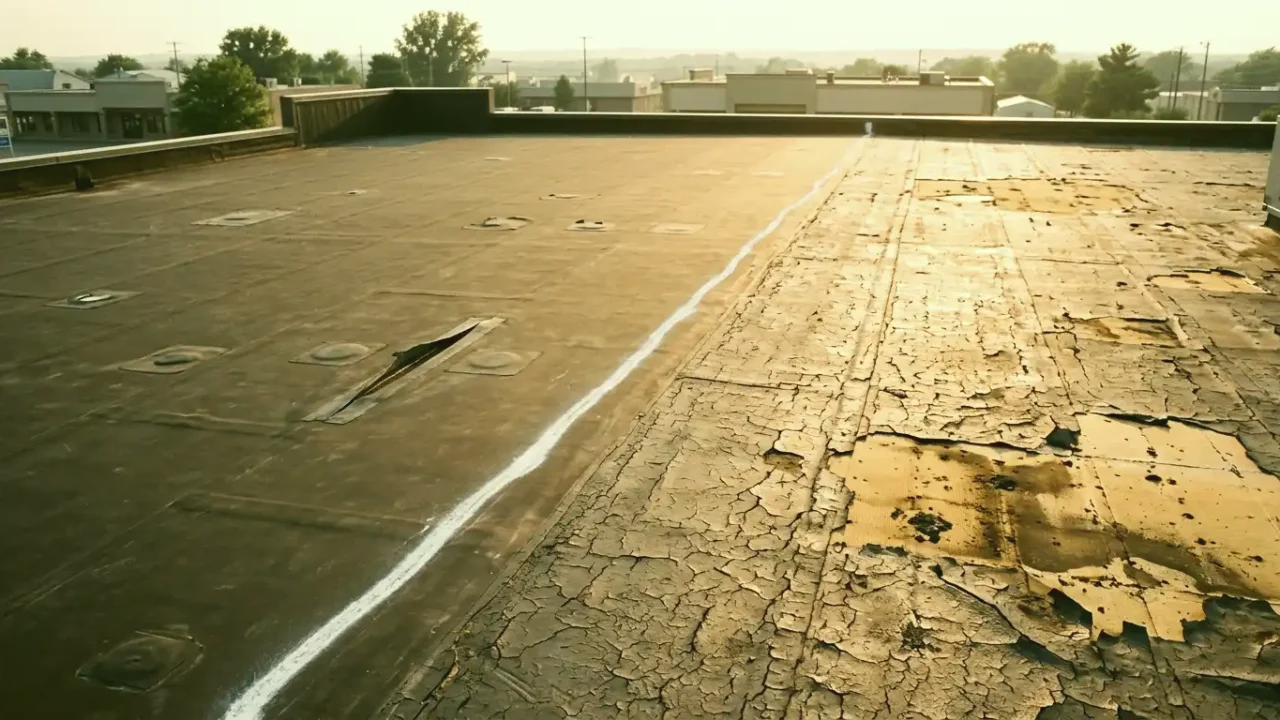
The commercial roof repair vs replacement question often arrives framed around age. The roof is eighteen years old, somebody quoted a replacement, and the owner wants to know whether it is time. Age alone is weak evidence, and a decision built on it can fail in both directions: it will replace sound roofs and it will keep pouring repair money into assemblies that were finished years ago.
The decision is made by evidence about the specific roof. Five factors carry much of the decision, and an owner who has them documented can make a more defensible call rather than relying on age alone or on whoever is standing on the roof.
Why age is a poor proxy
Published service life ranges describe a population of roofs, not yours. Two identical assemblies installed in the same year on two buildings across the road from each other can end up in completely different condition, because what actually consumed their service life was different: how well the details were built, whether the roof drains, how much traffic it takes, whether anyone maintained it, and whether moisture got into the assembly early.
Age is useful for one thing, which is setting expectations about what you are likely to find. A roof in the back half of its expected range deserves a more thorough look than one in its first years. It is a reason to investigate. It is not a finding.
The same applies in reverse. A roof well inside its expected life can be finished if the assembly is saturated or the deck is deteriorating, and no amount of remaining nominal service life changes that.
The five pieces of evidence that decide it
Read together, these five are what turns commercial roof repair vs replacement from an argument into a finding.
1. Whether the failures are in the field or at the details. This is the first and most clarifying distinction. Field membrane that is sound, with problems concentrated at flashings, terminations, curbs and penetrations, describes a roof with a detailing problem. Detail work is localised, so it can be considered separately from full replacement when the surrounding assembly remains serviceable. Field membrane that is failing generally, with splits, embrittlement, seam separation or surface deterioration spread across the roof rather than clustered, describes something systemic that repair does not solve.
2. How much moisture is in the assembly, and where. This can become decisive evidence, and it is covered on its own below because surface appearance alone cannot establish what is happening inside the assembly.
3. The condition of the deck. The deck is the one layer that cannot be replaced as part of an ordinary reroof without turning the project into something much larger. Corrosion on a steel deck, deterioration in a wood deck, or spalling and deterioration in concrete change the scope, the cost and sometimes the structural review required. Deck condition can remain uncertain before a project starts because it sits under the roof assembly.
4. Whether the roof drains. A roof that holds water is exposed to repeated ponding conditions, and a replacement can inherit the same drainage problem if the underlying cause is not corrected. This matters to the decision in a specific way: if the fix requires changing slope, that work happens inside the assembly, which means it happens during replacement rather than as a repair. Drainage problems therefore tend to pull a marginal decision toward replacement, because the correction and the replacement are the same project.
5. The pattern in the repair history. Not the count. The pattern.
Moisture can change the decision
Water inside the assembly can be one of the most consequential findings, and it may be invisible from the surface. A roof can look entirely serviceable while a substantial proportion of its insulation is saturated.
It matters for four reasons at once. Wet insulation loses thermal performance, so the building is paying for it continuously. It adds weight the structure was not designed to carry. It corrodes fasteners and deck. And it prevents adhesion, which means repairs and coatings applied over wet material do not bond properly and do not last.
That last point is what turns moisture into a decision maker rather than a condition. Once an assembly is substantially wet, many limited-scope repair options stop addressing the underlying condition. A coating over wet insulation seals the water in permanently. A patch over wet insulation may not bond. Recovering a wet assembly buries the problem under a new roof. The set of available actions narrows to removing the wet material, and once you are removing a significant proportion of the assembly, you are already most of the way into a replacement.
Moisture is established by survey rather than by opinion. Infrared thermography reads how quickly areas release stored heat after sunset, wet areas lagging behind dry ones. Electronic and nuclear meters take readings across a grid. Core cuts are then targeted to representative suspect areas so the scan can be checked physically and the affected layers can be identified. Industry guidance is consistent that survey results identify suspect areas and do not replace physical confirmation or professional interpretation, so a scan without cores is a strong indication rather than a conclusion.
A figure circulates widely in this conversation: that roughly a quarter of the assembly being wet indicates replacement. It is worth knowing the figure exists, and worth knowing it is not a rule. It is a discussion starting point, and it takes no account of where the moisture is, whether it is spreading, what the deck underneath is doing, what the membrane condition is, or what the building needs from the roof. A roof with a smaller wet proportion concentrated over a critical area with a deteriorating deck is in worse shape than one with a larger proportion spread thinly across a sound deck. Anyone applying the number as a threshold without the rest of the evidence is not making an assessment.
Reading repair history properly
Repair records are evidence, and most owners read them wrongly, as a running total. The total tells you what you have spent. The pattern tells you what is happening to the roof.
Three things are worth extracting from the history.
Location. Repairs scattered across unrelated parts of the roof suggest a general condition. Repairs concentrated in a few areas suggest specific causes: a drainage low point, a service route, a particular detail type, or a section that was built or replaced separately.
Cause. Repairs that each addressed a different, identifiable cause are a normal maintenance history on a working building. Repairs that all addressed the same symptom in the same place mean the cause was never found, which is a different situation entirely and says more about how the roof has been serviced than about the roof.
Direction. Are the intervals between repairs shortening? A roof needing attention at roughly the same rate over ten years is stable. One where the interval has halved twice is accelerating, and an accelerating roof reaches a decision point whether or not anyone plans for it.
This is also why documentation matters more than owners expect. A roof with no repair records is missing one of the five pieces of evidence, and the assessment has to work harder to reconstruct what the history would have shown.
The option between the two
Repair and replacement are presented as a binary and are not one. Sectional and staged approaches can be legitimate on large commercial roofs when the condition data supports separating the roof into distinct work areas.
The conditions that make a sectional approach sound are specific. The roof has to divide into areas with genuinely different conditions, usually because they were built at different times, sit over different occupancies, or serve different functions. There has to be a defensible boundary, typically at an expansion joint, a change in roof level, or a structural division, rather than a line drawn to fit a budget. The section being left has to have enough remaining service life to justify tying new work into it. And the tie-in itself has to be detailed properly, because a junction between new and old work is a transition like any other and will fail like one if it is treated as an afterthought.
Where those conditions hold, sectional work lets an owner address the worst area now and schedule the rest, which fits capital planning far better than a single large project. Where they do not hold, sectional work produces a roof with a seam through the middle of it and two different ages of material, and the saving is borrowed from the next few years rather than earned.
What sits outside the roof but inside the decision
Several factors have nothing to do with membrane condition and still belong in the analysis.
What the building does. A leak into a warehouse aisle is an inconvenience. A leak into a server room, a clean production area, a food storage space, an archive or a retail floor is a business event. The consequence of failure, not just its likelihood, should shape how much risk an owner is willing to carry on an ageing assembly.
What is on the roof. Mechanical equipment, and anything else mounted up there, has to be worked around during replacement. Equipment that is itself near end of life may be better replaced in the same window. Anything that would have to be removed and reinstalled is a cost and a coordination problem that belongs in the comparison.
Tenancy and occupancy. Who pays, who is disrupted, and what access is available all vary with the lease structure and the operating schedule. Recovery costs and responsibilities between landlord and tenant are a matter for the lease and for your own legal advisers, not something to be assumed from custom.
Capital timing. A roof that could reasonably last three more years with maintenance may be better replaced in a year when it can be planned, funded and scheduled properly than in whichever year it finally fails during a February thaw.
Planned building changes. If rooftop equipment, an addition, or another significant change to the building is coming, sequencing that against roof work avoids doing the same job twice.
What you should have before you decide
An owner can make this decision well with a defined set of information. If any of these is missing, the decision is being made partly on assumption.
- A record of what the assembly actually is: deck type, insulation, cover board if present, membrane type and attachment method, plus whether it is an original roof or a recover over something older.
- A condition assessment separating field membrane condition from detail condition, with photographs rather than descriptions.
- A moisture survey with confirming core cuts, mapped, showing extent and location rather than a yes or no.
- Observed deck condition at the core locations, and a note of anywhere the deck could not be seen.
- Drainage performance observed in wet conditions, including where water collects and how long it stays.
- The repair history, organised by location and cause rather than as a list of invoices.
- A statement of what correcting the underlying conditions, particularly drainage, would require.
- Your own assessment of consequence: what a failure in each area of the building would actually cost the operation.
Standardised approaches to the condition half of that list exist and have been studied formally. Research on membrane and flashing condition indexes developed for roof management systems treats condition as a numerical indicator derived from the type, severity and density of observed distress, with the explicit aim of making assessments repeatable between inspectors rather than dependent on judgement. The underlying principle is worth borrowing even without the formal system: an assessment that records what was found, where, and how severe it was gives you something you can compare against next year, and a verbal impression does not.
Questions owners ask at this point
A contractor says replacement, another says repair. How do I resolve it?
Ask both for the evidence behind the recommendation rather than the recommendation itself. Specifically: where is the moisture, how was it established, what condition is the deck in, and is the field membrane or the detailing failing. Recommendations that disagree usually rest on different amounts of information, and once the evidence is on the table the disagreement often resolves itself. Where it does not, an independent assessment that produces findings rather than a quotation is the cleanest way through.
Is a coating or restoration a real alternative?
It can be, on a structurally sound assembly that is dry, with membrane in suitable condition and detailing that can be properly integrated. It is not a way to defer dealing with moisture or failed details, and applied over either it makes the eventual replacement more complicated. Whether it is available on your roof is a survey finding, not a preference.
Does the decision change in winter?
The decision does not, but the options and the sequencing do. Some work is straightforward year round and some depends on temperature, dry substrates and weather windows. A roof that reaches a decision point in November is usually looking at a different plan than the same roof in May, which is an argument for assessing before the season rather than during a failure.
How long is an assessment good for?
Long enough to plan with, not indefinitely. Condition changes, moisture spreads, and a wet area mapped two years ago is not the same wet area today. For a roof at a decision point, current findings matter; for a roof being monitored, the value comes from repeating the assessment on a consistent basis so the direction of travel is visible.
Turning the question into findings
The commercial roof repair vs replacement decision is difficult only when it is made from partial information. With the assembly known, moisture mapped, deck observed, drainage watched and the repair history read properly, the decision becomes much clearer and the remaining work can move into planning.
A site-specific commercial roof assessment produces exactly that set of findings for your building. Our commercial roof replacement process starts by documenting the roof through assessment and inspection. Maintenance and repair remain options where the condition supports them, while replacement is scoped for systems we install when the evidence points there rather than as a default. Replacement planning and the decisions around it continue in our commercial roofing guides.
Commercial Roof Replacement
Read the related service page for practical details, then request a quote for your commercial or institutional property.