
Barrie Commercial Roofing and Winter-Ready Maintenance
Barrie sits in a snowier Central Ontario climate than much of the Greater Toronto Area, and winter roof management matters. Snow accumulation, thaw cycles and blocked drainage can hold water against flashings, drains and low areas for longer than a typical summer rain event. The building stock that has to handle those conditions ranges from industrial and logistics facilities along Welham Road and the Highway 400 corridor, to the Bayfield Street and Park Place retail zones, to institutional properties such as Royal Victoria Regional Health Centre and Georgian College.

Roofing Across Barrie's Industrial and South End
Barrie's industrial base centres on the areas around Welham Road, Morrow Road and the Big Bay Point Road corridor, where manufacturing, warehousing and service uses have accumulated over several decades. Buildings in this part of the city carry the kind of mixed roof history that comes from long occupancy: original membrane, additions built to a different standard, repairs that were never logged, and drainage configurations that have been modified without always improving on what was there before. The project, now marketed as Bayview Point Industrial Park, is adding a new generation of general-industrial buildings to the south end, alongside Barrie's established manufacturing and service properties.
The retail and institutional layer of Barrie, the Bayfield Street corridor, Georgian Mall and Park Place on the west side, the downtown on Kempenfelt Bay, RVH and Georgian College, produces an entirely different roofing context. These are occupied buildings with tenant hours, healthcare operations, academic calendars and customer flows that cannot simply stop for roofing work. On an institutional building, a reliable roof is a facility management expectation, not a maintenance discretion. On a retail strip, a leak in March can damage interior finishes that cost far more to replace than the roof repair that could have prevented it.
Local reference: City of Barrie economic development and Bayview Point Commercial Centre groundbreaking reporting
Barrie Commercial Roofing Services
For low-slope roof construction and membrane planning, see our commercial flat roofing guide.
Investigating Flat Roof Leaks After Winter
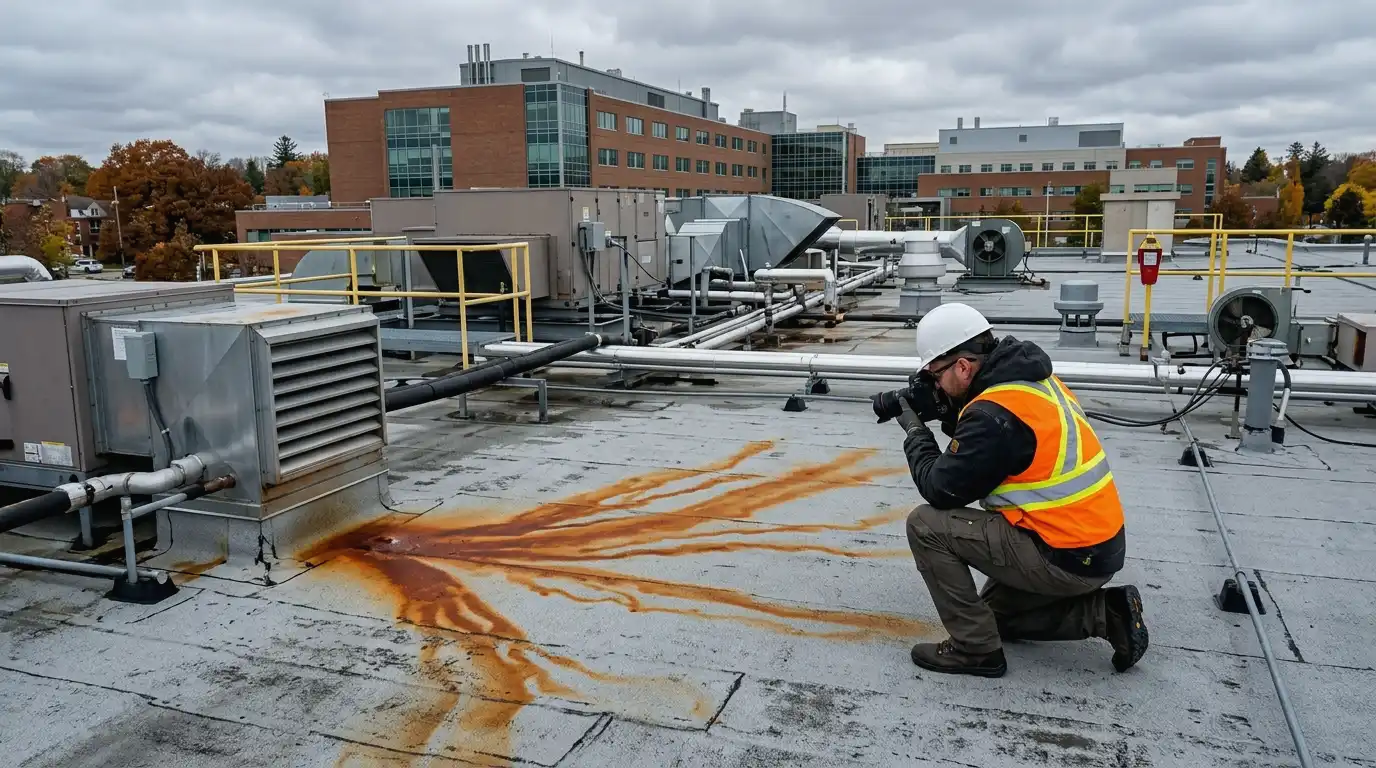
The most common timing for Barrie commercial roof leak calls is not during a squall, it is during the melt. Squalls deposit snow rapidly, but the membrane itself rarely fails during loading. What happens instead is that accumulated snowpack finds every vulnerable detail over a period of weeks: water migrates into insulation through a seam that was marginal, sits against a flashing base that has lifted slightly, or pools at a drain collar that has been partially blocked since November. When temperatures rise in late winter and the snow begins melting from the top down, that accumulated water moves, sometimes all at once. The investigation has to start on the roof, comparing interior leak timing against drainage geometry and the specific details that carry the most risk through freeze-thaw cycles.
Trace melt-season leaks to the detail that failed during winter loading
A Barrie roof that holds through a squall but leaks in March has typically failed at a detail, a drain collar, a curb base, a parapet transition, that was already marginal and that winter cycling finished off. The spring inspection should focus on those details, not on the membrane field as a whole.
Assess drainage capacity against actual Barrie snowpack
A drain sized for typical Ontario rainfall may not move melt volume quickly enough when two metres of accumulated snowpack begins releasing in a warm spell. On a Barrie roof with known ponding history, check whether the drain and overflow design was engineered for local conditions or imported from a lower-load southern Ontario reference.
Check addition transitions after the first hard winter in a new section
When a Barrie industrial building has been extended, the joint between old and new roofing is often the first place snow loading and freeze-thaw find a weakness. Transitions between different deck heights, insulation depths or membrane ages deserve close inspection after each winter, particularly during the first few years after an addition was completed.
Choosing a Roof System for Barrie Buildings
The system comparison for a Barrie commercial roof should begin with two questions that apply here more than almost anywhere else in southern Ontario: How much snow will this roof carry, and how fast can it drain when that snow melts? The answers shape the insulation strategy, the drain sizing and the membrane choice. PVC, TPO, EPDM, SBS modified bitumen and built-up roofing can all function in Barrie's climate when the complete assembly is correctly specified. The detailing around drains, overflows, parapet bases and curb flashings matters in every Ontario market; in Barrie it matters more because the conditions that stress those details are more severe and more frequent.

Barrie's growth also introduces a planning horizon question worth addressing during any replacement project. The south-end industrial expansion along Big Bay Point Road and the continued build-out of Highway 400-area commercial properties means some Barrie buildings are likely to be extended within a decade of their original construction. If an addition or mechanical expansion is possible, the replacement design should preserve logical section boundaries, serviceable drain positions and clear staging access so that future work can connect to the new membrane without having to cut through it prematurely.
Commercial Roofing SystemsPlanning Roofing Work Around Daily Operations
Roof Work Around Active Barrie Buildings
The staging constraints on a Barrie commercial roofing project depend entirely on what is operating below. At an institutional property, a hospital wing, a college building, a municipal facility, the requirements around noise, vibration, dust, access and interior protection may be more restrictive than at an industrial building, and the consequences of a weather event above a healthcare space are more immediate. At a Bayfield Street retail property, tenant hours and customer access determine when roofing work can begin and when it must stop for the day. At an industrial facility on Welham Road or Morrow Road, the constraints are more likely to involve truck scheduling, loading zones and secured areas. Each of those is a different plan, not variations on the same plan.
Planning Barrie Roof Inspections and Maintenance
The most useful maintenance intervals for a Barrie commercial roof are tied to weather, not months. A thorough inspection before freeze-up, typically October or early November, can clear drains, identify marginal details that will not survive another winter and give the owner a defensible record of the roof's pre-winter condition. A post-melt inspection in April or May documents what the winter revealed. Between those visits, the record should note any significant snowfall events, any interior leak calls and any rooftop trade work. On an institutional building at RVH or Georgian College, that log is also the foundation for capital planning discussions that typically happen well before the budget year when the work is needed.
A seasonal log of drift locations, drain blockages and winter leaks helps a Barrie owner see which areas of the roof are repeatedly stressed.
Roof maintenance planningServing Barrie's Commercial and Industrial Areas
In Barrie, our scope reaches industrial and manufacturing buildings along Welham Road, Morrow Road, Ferndale Drive and the Big Bay Point Road and Bayview Drive corridor, retail and plaza properties on Bayfield Street and in the Park Place and Georgian Mall areas, institutional buildings including properties near Royal Victoria Regional Health Centre and Georgian College, and commercial properties throughout Downtown Barrie and the South Barrie area. Roof size, drainage, equipment and access vary across Barrie, so the work is planned around the individual property.
- Employment & commercial districts
- Welham Road industrial area · Morrow Road industrial area · Ferndale Drive industrial area · Bayview Drive and Big Bay Point Road industrial corridor · Bayfield Street retail corridor · Park Place commercial area · Georgian Mall area · Bayview Drive industrial area · South Barrie industrial area · Mapleview and Huronia industrial area · Bayview Point Industrial Park (80 Big Bay Point Road)
- Neighbourhoods & nearby communities
- Downtown Barrie · South Barrie · Bayfield corridor · Painswick · East Barrie · Kempenfelt Bay waterfront

Barrie Roofing Questions: Snow and Drainage
Why do Barrie commercial flat roofs leak most often in March and April rather than during the actual snowstorms?
Georgian Bay squalls deposit snow quickly, but the membrane does not fail during loading, it fails at details that have been stressed over weeks of winter cycling. Water migrates slowly through a marginal seam, sits against a lifted flashing base, or pools at a partially blocked drain all winter without producing an interior drip. When temperatures rise in March and the pack begins melting, that accumulated water moves fast. A drain that kept up with normal rainfall cannot always handle the volume of two months of snowpack releasing over a warm week. The spring inspection should focus on the details that bear the most winter stress, drain collars, parapet bases, curb flashings and addition transitions, because those are where the winter's work becomes visible.
What does Georgian Bay lake-effect snow actually mean for drainage design on a Barrie flat roof?
Lake-effect squalls off Georgian Bay produce rapid, heavy snowfall events, single storms can drop 40 to 50 centimetres, that sit on a flat roof until temperatures rise. Annual totals in Barrie regularly exceed two metres, and snow can be on the ground for roughly 100 days a year. A drainage design calibrated to handle typical Ontario rainfall volumes is not necessarily adequate for the melt volume produced by that snowpack when a warm spell arrives. The combination of drain sizing, overflow capacity, roof slope and insulation type all affect how quickly a Barrie roof moves meltwater to the building's drainage system. If a roof was designed to a GTA reference standard and then used in Barrie, that gap in drainage capacity can show up as persistent ponding every spring, not because the roof is failing, but because it was not sized for the local load.
Should a Barrie building owner be concerned about snow accumulation weight on a commercial flat roof?
The structural snow load question is more relevant in Barrie than in most southern Ontario markets. The Ontario Building Code references specific ground snow load values by municipality, and the design figure for Barrie reflects Georgian Bay conditions, it is among the higher values for a city of Barrie's size in the province. Older buildings designed to earlier code cycles may have been built to lower load values, and a building that receives an addition or rooftop equipment may also have its load distribution changed in ways that were not re-engineered at the time. If a roof has sustained heavy snowpack and shows unusual deflection, cracking at parapet walls or drain areas, or a sudden increase in ponding patterns, a structural review is appropriate before the next winter season.
How should an institutional building in Barrie, a hospital wing, a college facility, a municipal arena, approach flat roof replacement differently from an industrial property?
The sequencing and staging constraints are more demanding. An institutional building typically cannot pause operations for roof work, which means the replacement plan has to be built section by section around occupancy schedules, emergency access requirements and interior protection standards that a warehouse does not share. Healthcare facilities, academic buildings and arenas all have specific expectations around noise, dust, vibration and the consequences of a weather event over an occupied space. Beyond the operational constraints, the capital planning horizon is also different: an institution planning a 20-year facility strategy needs a roof condition assessment that connects to the capital plan, not just a quote for the next repair. A phased replacement program with documented section-by-section priorities is typically more useful than a single all-at-once replacement event.
Can commercial roofing work in Barrie be done in winter, or does everything have to wait until spring?
Some work can be done in winter, but the temperature, precipitation and ice conditions in Barrie narrow the practical window more than they do in southern Ontario. Cold-applied adhesives, torch-applied membranes and self-adhered systems all have temperature limits, and a Barrie January is often outside those limits for meaningful stretches. Emergency work to control active water entry can proceed in most conditions with temporary materials and protection measures, followed by permanent work when the surface can be properly prepared. Planned replacement or significant repair should be scheduled for the best available window in Barrie's shoulder seasons, late spring through early fall, when the membrane can be installed correctly and the building's drainage can be tested before the next winter season begins.
What should a Barrie owner confirm about snow load before planning new roof work?
Confirm with a qualified engineer whether the structure was designed for current snow loads, especially where drifting forms against parapets or rooftop units. Do not add insulation or ballast without that check. Ask the roofer how drainage will be kept clear in winter and how snow removal will avoid damaging the membrane.
Commercial Roofing Around Simcoe County and Georgian Bay
Plan the Barrie Roof Around Snow, Drainage and Building Access
Describe the Barrie building, how old the roof is and where snow or meltwater has caused trouble. We will help you work out whether a repair, a snow-load-aware review or a replacement scope comes first.