
Ajax Commercial Roofing for Warehouses and Plazas
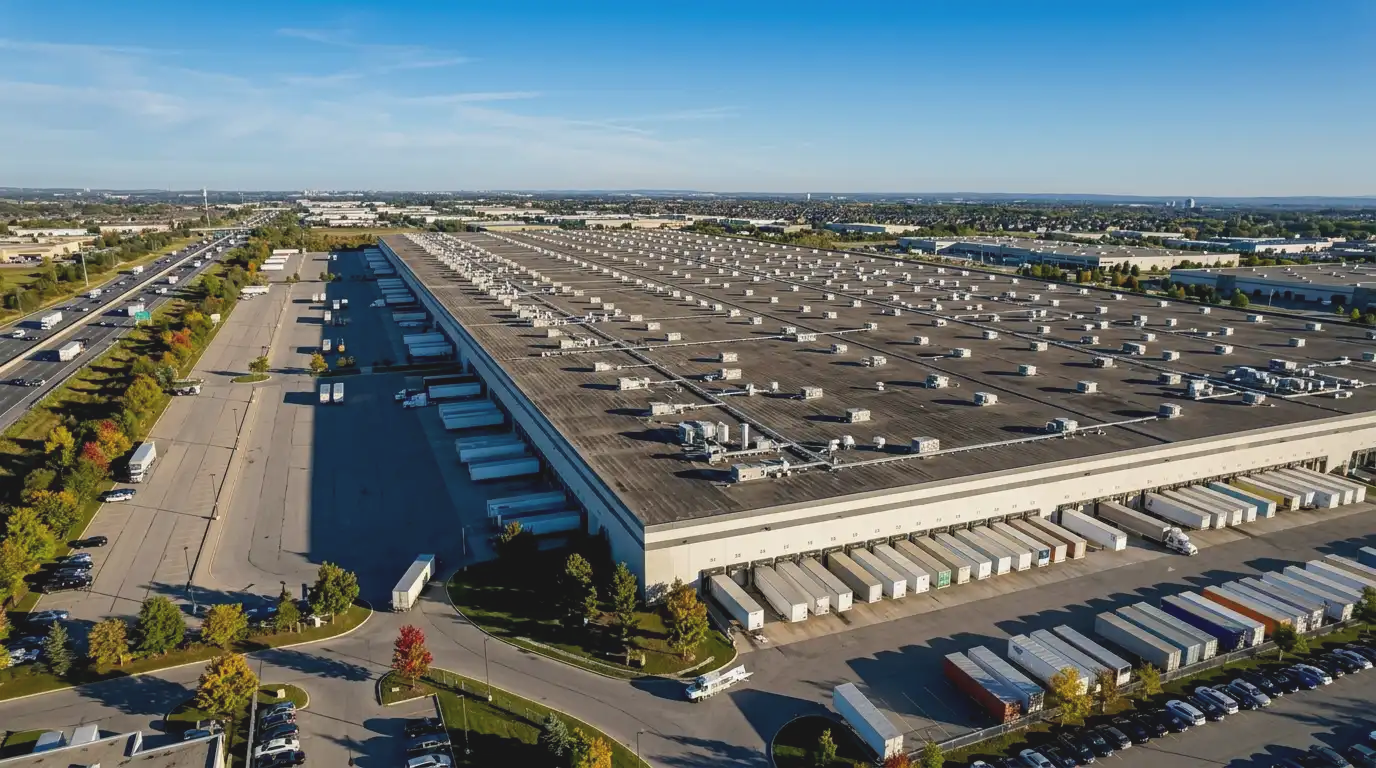
Ajax has become one of Durham Region's most active industrial and logistics addresses. The GTA East Industrial Park near Salem Road includes Amazon's fulfillment centre and H&M's 716,827-square-foot distribution centre on Kerrison Drive East. Separately, Ajax Industrial on the Park at Bayly Street West and Church Street South is a three-building warehouse and distribution campus with its own large-format industrial roofs.
How Ajax's Building Mix Shapes Every Roof Decision
The commercial and industrial property base in Ajax ranges considerably in age and scale. Older buildings around Commercial Avenue and the Central industrial area carry mixed roof histories: original assemblies, additions from different eras, repairs that were never documented, and drainage configurations that have shifted as buildings changed. Newer large-footprint facilities near Kingston Road East and the Audley Road corridor tend to be single-era builds, but their scale introduces its own complexity. Long drainage runs, dozens of rooftop-unit penetrations, and roof sections large enough that one failing drain or blocked scupper can create a substantial ponding zone that is not obvious from the ground.
Lake Ontario also influences Ajax weather, so winter and early-spring inspections should pay close attention to freeze-thaw conditions, snowmelt and drainage. Water that freezes in a vulnerable detail, thaws and then refreezes can expose weaknesses around flashings, drain collars, curb bases and older seams. The useful approach is to record when a leak appears and compare that timing with the roof's drainage and exposed details rather than assuming every winter leak has the same cause.
Local reference: Town of Ajax Invest Ajax commercial and industrial resources

Ajax Commercial Roofing Services
For low-slope roof construction and membrane planning, see our commercial flat roofing guide.
Find Where the Water Entered, Not Just Where It Appears Inside
On a large Ajax distribution or manufacturing roof, a water stain on a ceiling tile two-thirds of the way down a bay can originate almost anywhere on the membrane above it. Water entering at a failed curb flashing near an RTU can travel along deck flutes, saturate insulation or follow mechanical channels before it drops through an entirely different part of the building. The investigation has to begin on the roof, with a record of drainage paths, low spots, rooftop equipment locations and existing repairs, not at the interior drip point. On a smaller commercial property, the principle is the same even if the roof is smaller: locate the entry point before confirming the repair scope.
Map drainage geometry on large roof sections
Ajax distribution and logistics buildings can cover an enormous footprint. Before any repair decision, map the drainage path from each low point to the nearest internal drain, scupper or overflow, and confirm those paths are clear and functioning. A blocked drain on a 500,000-square-foot roof can produce a ponding zone that the building operator may not notice until it starts moving water inside.
Inspect the freeze-thaw details in early spring
Lake Ontario proximity means Ajax roofs cycle through freeze-thaw more frequently than most Ontario markets. Drain collars, curb bases, parapet copings and perimeter flashing are worth inspecting once the freeze season ends, before spring rains add more volume to details that may have shifted during the winter.
Trace new leaks back to the most recent rooftop work
Ajax facilities with regular HVAC servicing, electrical upgrades or gas-line modifications should consider whether new leaks track to recent trade activity rather than spontaneous membrane failure. Unmarked pitch pockets, incomplete curb flashings and temporary penetrations left open after service calls are common culprits that an inspection can quickly rule in or out.
Roof Systems for Ajax Properties
In Ajax, the membrane choice usually follows what happens below the deck: dock traffic, rooftop equipment loads and how much of the building has to stay in service. On an Ajax logistics facility, the practical comparison should include how each system handles high rooftop-unit density, trade traffic from regular mechanical servicing, the building's exposure to lake-driven winds, the deck type, and the drainage design. On a smaller occupied property near the Harwood Business Park or Pickering Village, access logistics, parapet conditions and the interior use pattern may weigh more heavily than system longevity statistics.

Ajax's newer large industrial developments also create a specific forward-looking consideration. Many recent buildings were constructed or expanded with rooftop solar potential in mind. If solar is on the horizon for a property, the membrane choice, attachment method, ballast strategy and drainage layout should account for it now rather than after installation. Adding an array to a roof that was not designed with it in mind tends to create complications around drainage access, service routes and future membrane replacement that are far more expensive to untangle than to anticipate at the outset.
Commercial Roofing SystemsPlanning Roofing Work Around Daily Operations
Planning Roof Work Around Ajax Operations
At a busy Ajax logistics or distribution facility, the operations plan needs to precede the roofing plan. Confirm truck arrival windows, roof-access constraints, crane or material-lift positions, loading bays that cannot be blocked, and any interior areas, cold storage, active production lines, pharmaceutical or food-processing zones, that need additional weather protection during construction. Phase the work into manageable daily sections with waterproof stopping points that can be reached in defined working hours. Roofing crews should never open more membrane than can be reliably protected by end of day, and any risk to active operations below should be discussed and agreed in writing before the roof is opened.
Better Records for Aging Roofs
A structured maintenance log pays dividends on an Ajax facility over time. Record inspection dates consistently using section labels that match a roof plan, note drain conditions and any standing water after significant rainfall, document the scope and location of every repair, and photograph each completed repair zone. After any rooftop trade work, HVAC, electrical, gas, communications equipment, add a roof check to the close-out process. Over five years, a good log can tell you whether one section is stable, whether another is deteriorating faster than expected, and where capital replacement budget should be directed first. Without it, every roof question starts over from the same blank page.
In Ajax, a dated log of dock-door leaks, rooftop-unit service visits and drain clean-outs gives the next roofer a record to work from instead of a guess.
Roof maintenance planningRoofing Across Ajax Business Districts
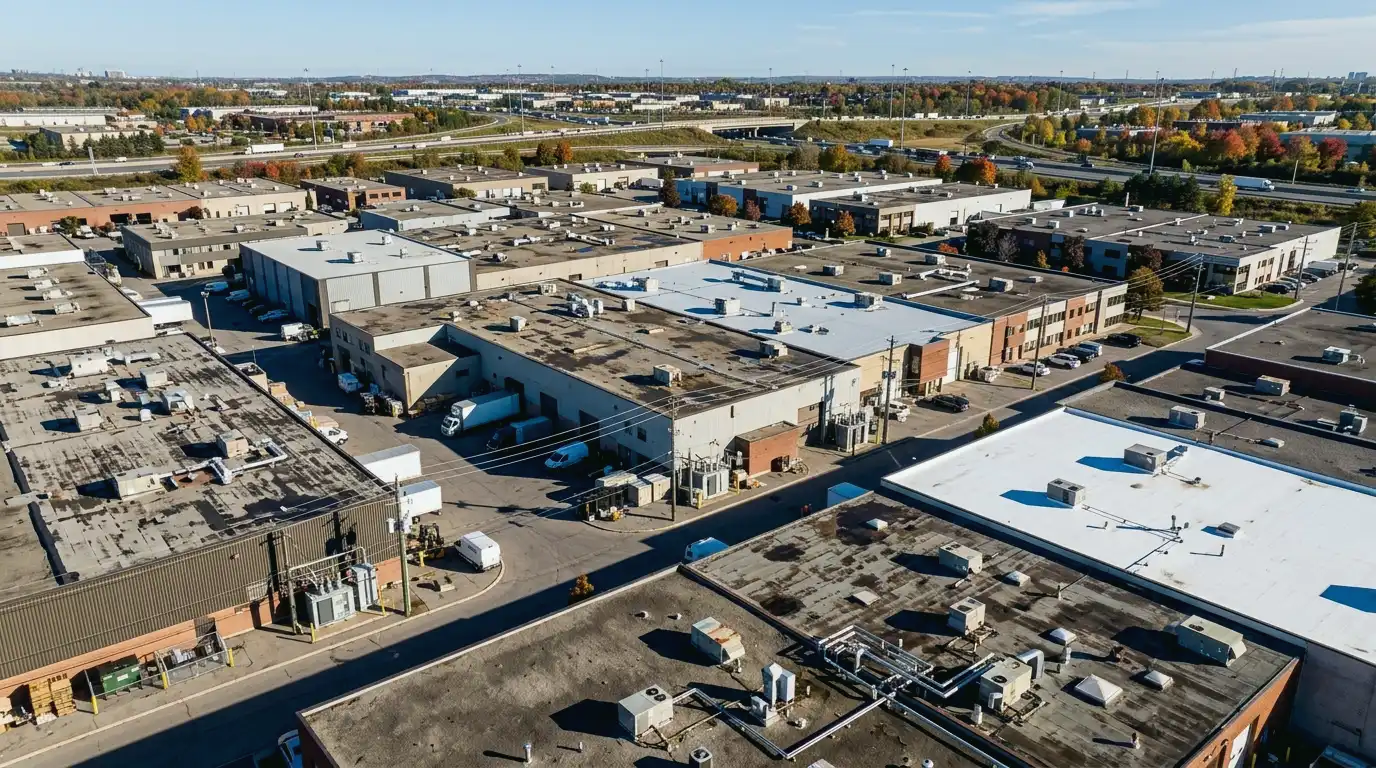
Ajax roof work takes in properties across Ajax, including the Kingston Road East logistics corridor, Audley Road and Audley Road North business areas, the Carruthers Creek and Harwood business parks, established industrial buildings in the Central industrial area and along Commercial Avenue, and occupied commercial and retail properties throughout Pickering Village, Downtown Ajax and Westney Heights. For Ajax properties, the roof condition, drainage, access and building use still determine what work makes sense.
- Employment & commercial districts
- Kingston Road East logistics corridor · Audley Road Business Area · Audley Road North Business Park · Carruthers Creek Business Park · Harwood Business Park · Central industrial area · Commercial Avenue industrial corridor · Salem Business Area · Notion Road industrial area · GTA East Industrial Park (Salem Road and Kerrison Drive East) · Ajax Industrial on the Park (Bayly Street West and Church Street South)
- Neighbourhoods & nearby communities
- Downtown Ajax · Pickering Village · Westney Heights · Audley North · Audley South · Carruthers Creek
What Ajax Facility Managers Ask Before Approving a Roof Scope
How do I know whether ponding on an Ajax distribution roof is a blocked drain or a drainage design problem?
A single blocked drain typically creates a localised pool directly around the drain itself. Drainage design problems show as broader, irregular ponding that persists even when drains are clear, because the roof surface is not sloped to move water toward the drain in the first place. On a large Ajax logistics roof, this can be traced by mapping where water sits 24 to 48 hours after a significant rainfall. If water covers a large area away from the drain point, the slope or the insulation compression, or both, deserve closer attention. The two problems require different solutions: clearing a drain is maintenance; correcting a drainage design shortfall usually means tapered insulation or a drain relocation as part of a repair or replacement scope.
Can a fully operating Ajax warehouse or logistics facility stay open while the flat roof is being replaced?
Usually yes, but it depends entirely on how the project is planned. The work needs to be broken into phased sections with defined daily waterproof stopping points, and the schedule must be built around the building's actual operations, truck windows, restricted interior zones, loading-dock activity, and any process areas that cannot tolerate weather exposure or vibration. Replacement on an active facility is not inherently riskier than on an empty one, but it requires a roofing crew experienced working around live operations and a site plan that treats the operational constraints as fixed rather than flexible.
Why does my Ajax commercial roof seem to develop new problems every March and April?
Ajax's proximity to Lake Ontario creates a local climate where freeze-thaw cycles are more frequent and more compressed than they are inland. During winter, the lake moderates temperatures, pushing readings back toward zero more often than a fully continental Ontario location would see, which means roofs cycle through freezing and thawing repeatedly before spring actually arrives. Water that has migrated into insulation or stalled at a detail during a cold spell can expand, shift and find a new path when temperatures rise briefly, then freeze again before it fully drains. By early spring, the cumulative effect becomes visible as interior leaks. The practical response is a targeted spring inspection focused on drain collars, curb flashings and perimeter details, the locations most sensitive to repeated cycling, rather than assuming the whole roof has failed.
What should be confirmed before a building owner signs off on new rooftop HVAC equipment at an Ajax commercial property?
New rooftop mechanical equipment typically involves new or modified curbs, penetrations for refrigerant lines, electrical conduit, gas connections and condensate drainage, plus significant foot traffic on the membrane during installation. Before the HVAC contractor leaves site, a roofing review should confirm that all new penetrations and curb flashings are properly sealed, any walk-path or staging damage to the membrane has been identified and repaired, and any temporary openings or tie-ins have been fully closed. This is a common source of roof leak calls after equipment installation, not because the mechanical work was done badly, but because the roofing details around it were not checked as part of the sign-off.
If I am considering rooftop solar on an Ajax warehouse, does the roof need to be replaced first?
Not automatically. If the roof is in genuinely good condition with meaningful remaining service life, it can support a solar array without a prior replacement. The questions that matter are: How much life does the membrane realistically have left? Are there unresolved moisture or drainage problems? Will every drain and scupper remain accessible under or beside the array? Will maintenance and emergency-service access be preserved for the full service period of the installation? If the honest answer to the life question is that the roof is within several years of needing replacement, coordinating the replacement before the array goes in is often the better sequence. Working around or temporarily removing panels for a membrane replacement mid-life adds substantial cost and complexity that proper sequencing avoids.
What drives the price of re-roofing a distribution building in Ajax?
Roof area is only the starting point. Tear-off versus recovery, wet insulation found under the membrane, tapered drainage, the number of curbs and penetrations, crane or hoist access, and whether racking and dock activity must keep running all move the number. Ask for a written scope that lists insulation and deck allowances separately so quotes can be compared on the same basis.
We Also Cover the Rest of the Durham Lakeshore
Send Us the Ajax Building and What the Roof Is Doing
Send us the address, the building use and where water has shown up. For a distribution or manufacturing roof in Ajax, we will sort what needs a repair visit from what needs a scoped assessment.