
Kitchener Commercial Roofing for Industrial Operations
Kitchener has one of the most diverse commercial roof inventories in southern Ontario. The City operates three major business parks, Bridgeport, Huron and Lancaster, alongside a dense urban fabric of older manufacturing buildings, converted factories, research facilities, retail corridors and health-related properties. The Grand River valley climate gives Kitchener a pronounced continental character: sustained cold, heavy snowfall and a relentless late-winter freeze-thaw pattern that is harder on roofing materials than a climate with a single clean freeze and a single clean thaw.

Kitchener Manufacturing and Business-Park Roofs
Buildings in the Kitchener urban core, former textile mills, metal fabrication shops and food-processing facilities that have been adapted for new uses, often carry layered roof histories. Multiple reroofing events on the same building, each responding to an immediate problem rather than a systematic plan, can leave an assembly that is difficult to assess from the surface alone. A test cut in the right location, combined with interior mapping and a review of any available maintenance records, is the only reliable way to understand what is actually between the deck and the top membrane.
Newer business park construction in Huron and Lancaster brings different concerns. These buildings are often large, relatively new and well-documented, but their rooftop equipment inventories grow as tenants make changes over lease terms. When a new HVAC unit is added or an exhaust configuration is modified, the roofing implications are usually the last thing the tenant or their mechanical contractor considers. A standing agreement between a property manager and a commercial roofer to review any roof penetration work within the business park before it is sealed up permanently is one of the most cost-effective maintenance steps available.
Local reference: City of Kitchener economic-development and business-park planning information

Three Kitchener Roof Decisions to Clarify Early
Kitchener commercial roofing decisions span older adapted buildings and newer business parks. Establish roof age, recent rooftop changes and operating constraints before choosing a repair or replacement path.
Confirm the real roof assembly
Older and adapted buildings can carry multiple roofing generations. Use records, test information and section mapping before assuming what is below the visible membrane.
Commercial roof inspectionsTie new penetrations to the roof record
When HVAC or exhaust equipment changes, document the new roof detail and inspect the surrounding travel path soon after the work is complete.
Commercial roof maintenanceMatch repair scope to the actual defect
Recurring leak work should distinguish membrane damage from flashing, drain, curb or penetration problems and confirm compatibility with the existing system.
Commercial roof repairKitchener Commercial Roofing Services
For low-slope roof construction and membrane planning, see our commercial flat roofing guide.
Map Tenant Zones and Roof Leak Sources
Keep a simple log of when leaks appear in Kitchener commercial buildings: temperature at time of event, whether it followed snowmelt or rain, how long after weather change the interior drip started. That log differentiates a drainage problem from a membrane defect from a freeze-thaw-related failure at a parapet or edge condition. Each has a different starting location for investigation and a different correction.
Older core manufacturing buildings with layered assemblies
Buildings that have been reroofed multiple times carry unpredictable insulation conditions under current membranes. Test cuts in areas near known problems confirm the assembly actually present before a repair strategy is chosen.
Business park tenant additions and HVAC changes
Huron and Lancaster business park properties accumulate undocumented rooftop penetrations as tenants modify mechanical systems during lease terms. Inspect new HVAC curbs and electrical penetrations for complete flashing before a new lease term begins.
Freeze-thaw damage at parapets and perimeter conditions
Kitchener's late-winter temperature cycling concentrates damage at parapet bases, counter-flashings and perimeter edges where water accumulates before it can drain. These areas should be inspected in spring before superficial thaw-season patching masks the actual scope of damage.
Roof Systems for Kitchener Businesses
In Kitchener's continental climate, every roofing system depends on correct insulation, appropriate attachment and proper drainage more than on membrane type. A TPO system that drains well and maintains its insulation bond will outlast a modified bitumen system on a roof with chronic drainage problems. Specify attachment and insulation methods appropriate for the deck type and wind exposure, and pay close attention to parapet and perimeter details that will experience the most stress from Kitchener's freeze-thaw cycling.
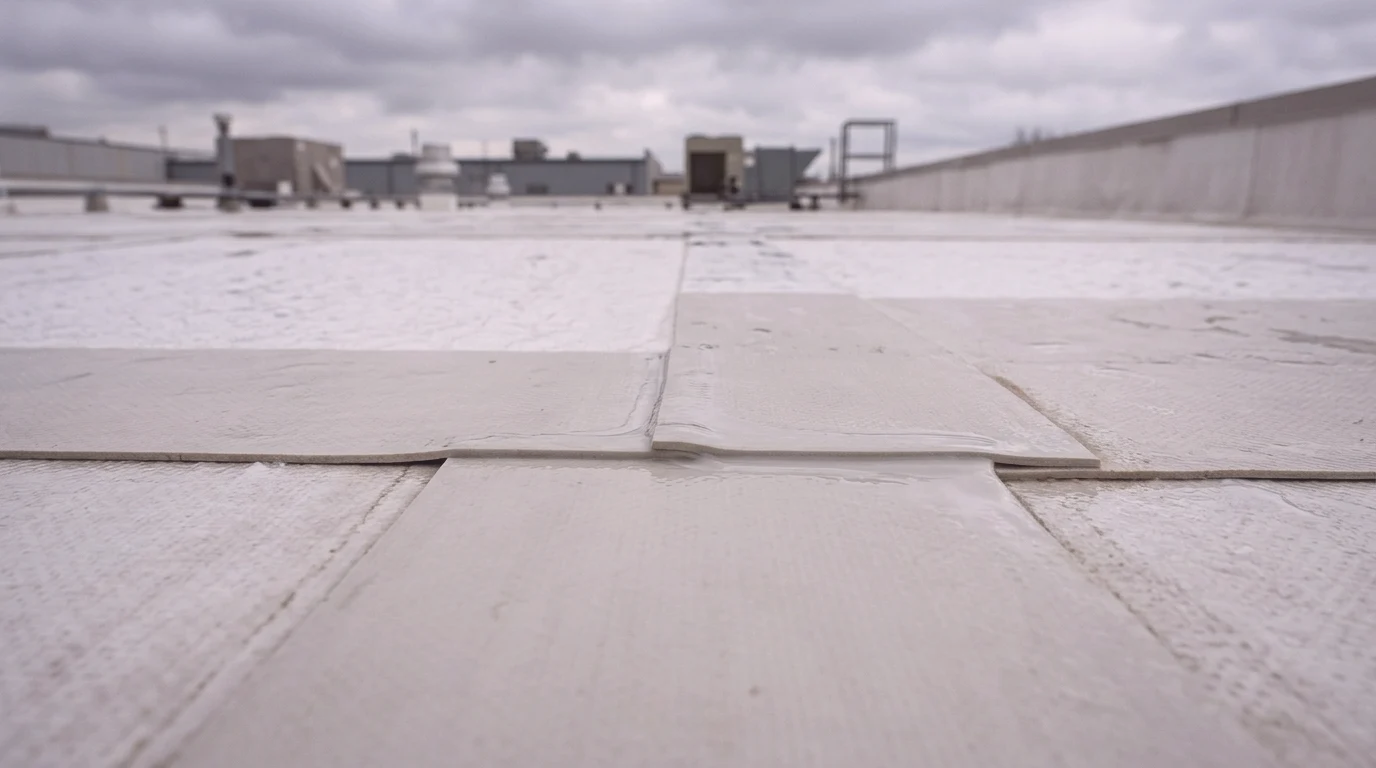
The King Street corridor and older areas of downtown Kitchener add a category worth noting: heritage or near-heritage commercial buildings with modified flat-roof areas that require sensitivity around parapets, wall cladding and visual details. Roofing work on these properties should account for the interface between the membrane and the building envelope as a whole, particularly where modified bitumen or torch-applied systems could affect masonry or historic facades.
Commercial Roofing SystemsPlanning Roofing Work Around Daily Operations
Roof Work Around Active Manufacturers
A Kitchener manufacturing plant and a King Street multi-tenant office building require different project-planning approaches, but both need a clearly mapped scope before work begins. For manufacturing, identify production-sensitive areas, air intake locations, shift schedules and loading dock access. For multi-tenant buildings, confirm where crane or hoist positions can be set without blocking pedestrian or vehicle access, and communicate with each tenant about which day or days their section of roof will be in an open-work state.
Kitchener Roof Maintenance Planning
Schedule a late-March or early-April inspection after the final freeze-thaw cycle has completed, focusing on parapet bases, perimeter metal, counter-flashings and drain connections. The cumulative damage from a winter of cycling is most visible then and can be addressed before warm-weather building use increases roof traffic. Add a late-September inspection to clear drain guards, confirm overflows are clear, and identify any areas of membrane blistering or seam separation that have developed through the summer. Event-driven reviews after ice storms are worth adding when those events are significant.
For a Kitchener innovation or manufacturing tenant, a log that notes sensitive areas helps coordinate roof work.
Roof maintenance planningRoofing Across Kitchener Business Parks
In Kitchener, we serve manufacturing, warehouse, institutional and multi-tenant buildings across Kitchener, including Huron Business Park, Bridgeport Business Park, Lancaster Corporate Centre, King Street commercial corridor properties and Downtown Kitchener. For each Kitchener building, we base the recommendation on the roof that is there now rather than the neighbourhood name.
- Employment & commercial districts
- Huron Business Park · Lancaster Business Park · Bridgeport Business Park · Homer Watson Business Park · Grand River West Business Park
- Neighbourhoods & nearby communities
- Downtown Kitchener · Bridgeport · Huron Park

Kitchener Roofing Questions From Owners and Tenants
A Kitchener tenant installed a new rooftop HVAC unit and we now have a leak. Who is responsible, and what should we do first?
Responsibility questions are for legal counsel, but the practical first step is the same regardless: have the flashing around the new curb inspected by a commercial roofer before it is repaired, so there is a documented record of what the mechanical contractor's work left behind. Many rooftop-unit installations are done competently from a mechanical standpoint but leave incomplete, incompatible or improperly terminated roof flashings. The roof around new penetrations should always be reviewed and accepted by a roofer, ideally before the mechanical contractor leaves the site, which is easier to enforce as a lease condition than to sort out after a leak has caused interior damage.
Does Kitchener's inland climate require a different insulation specification than cities closer to Lake Ontario?
Inland Ontario climates like Kitchener's are harder on roofing assemblies in winter because they lack the temperature moderation that proximity to a large body of water provides. The freeze-thaw cycle count through a typical Kitchener winter is higher than in a coastal location, and the temperature swings between warm days and cold nights in late winter are more pronounced. Higher insulation R-values reduce heat loss through the assembly, which limits the temperature differentials that drive condensation and frost accumulation within the insulation layer. This is worth raising explicitly with a roofing contractor during replacement planning, since it affects both material specification and long-term performance.
How should a Kitchener commercial property manage reroofing when the building has sections from three different decades?
Start with a section-by-section condition assessment rather than an overall roof-age estimate. Each section should be evaluated for membrane type, attachment method, insulation condition and remaining service life independently. Replacement sequencing should follow condition and risk, the sections with the worst insulation saturation or highest leak density first, regardless of which section is oldest by calendar year. Phase boundaries should align with structural expansion joints, drainage divides or elevation changes where one section can be completed and made watertight independently of the others.
Why is a Kitchener commercial roof more likely to show damage in spring than in November?
A roof may absorb damage throughout the winter without displaying visible exterior symptoms until temperatures rise. Water that entered through a small defect in November travels through insulation, freezes in place, and does not appear as an interior drip until the insulation thaws in spring. The thaw-water load then exceeds what the membrane and details can contain, and a building that survived five months of winter appears to start leaking all at once in March. The spring leak is often not a spring problem, it is the cumulative result of the winter, expressed when conditions finally allow the stored water to move.
What should be in a Kitchener commercial roof inspection report to make it useful for budget planning?
A useful report identifies each roof section separately and estimates its remaining service life based on what was actually found, membrane condition, evidence of moisture in the insulation, drain performance, repair density and detail condition. It should include photographs from consistent reference points so the report can be compared to previous and future inspections. It should prioritize findings, what needs immediate attention versus what can be managed with maintenance for another few years. Vague language like 'fair condition' or 'end of life approaching' without supporting evidence or a specific recommendation is not useful for a building owner who needs to make a capital request.
How can a Kitchener tenant protect operations during roof replacement?
Agree with the landlord and roofer on work hours, noise limits and interior protection. Identify equipment or processes that need extra safeguards and schedule the most disruptive tasks for quiet periods. Make sure there is a clear contact person for daily questions.
We Also Roof in Waterloo, Cambridge and Guelph
Start the Kitchener Roof Plan With an Honest Condition Review
Occupied buildings call for careful roof planning. Share the Kitchener address and what is inside, and we will help shape a plan that protects your operation.