
St. Thomas Commercial Roofing for Industrial Growth
St. Thomas is experiencing a level of industrial investment that hasn't been seen in decades. Meanwhile, the city's established industrial and commercial areas, including the municipal industrial park and the downtown commercial core, continue to operate and require the same careful roof management as any other Ontario industrial city.

St. Thomas Roof Management Now Has to Account for Two Very Different Industrial Contexts
The new PowerCo campus and its anticipated supply chain cluster will create a generation of brand-new commercial and industrial buildings. These facilities need roof records established from the first occupancy, plans, warranties, drain locations, photographs, before production equipment, process utilities and logistics changes start accumulating undocumented modifications. Across the rest of the city, existing manufacturing and commercial buildings are at various stages of their service lives, some approaching second or third reroofing cycles.
The practical difference between the two contexts is this: on a new building, the most important roof work is preventive documentation and early inspection. On an existing building, it's honest condition assessment and a phased plan that matches remaining service life to the owner's development horizon. Neither approach works as a template for the other. A blanket inspection schedule designed for a 1990s industrial park doesn't serve a new EV-supply-chain facility, and vice versa.
Local reference: City of St. Thomas PowerCo and Mega Site industrial development

St. Thomas Commercial Roofing Services
For low-slope roof construction and membrane planning, see our commercial flat roofing guide.
St. Thomas Industrial Leaks Require Basin-First Investigation on Large Manufacturing Floors
St. Thomas manufacturing buildings can have very large roof areas with multiple interior drain basins and spans that carry water significant distances before it shows up inside. Start from the interior location and compare it against the relevant drainage basin rather than heading directly to the most visible surface defect. On older industrial buildings, also compare the leak with any recent contractor activity on the roof, a new curb or conduit installed for a production upgrade can be the source of a leak that only presents six months later during a heavy rainfall.
Established St. Thomas industrial park buildings
Map drainage basins and existing penetrations on older manufacturing buildings so recurring leaks can be traced to the actual entry point rather than the most convenient surface patch.
New PowerCo and supply-chain facilities
Commission a baseline inspection while the roof is still original so every future contractor visit and equipment addition is measured against a clean documented starting point.
Downtown St. Thomas Older-Building Interfaces
Include parapets and wall transitions in leak investigations on older commercial properties where vertical fabric may be contributing water above the membrane.
Specify St. Thomas Roof Assemblies for Manufacturing Load, Process Utilities and Long-Term Change
St. Thomas has newer large-scale industrial activity alongside older commercial roofs, so schedules and records matter. The appropriate choice depends on deck type, insulation, vapour control, attachment, drainage, rooftop traffic, penetration density and the specific occupancy. A battery component manufacturing facility has different vapour and chemical exposure considerations from a food-processing plant or a warehousing operation. Those differences belong in the specification, not in a generic membrane recommendation.

On any St. Thomas replacement project, use the opportunity to correct problems the previous roof revealed: remove abandoned penetrations from previous tenant and equipment changes, rebuild curbs that were improvised by non-roofing contractors, correct drain sumps and establish service paths. On a new PowerCo or supply-chain facility, coordinate planned equipment and utilities with the roof layout before installation begins, it is far less expensive to detail a planned penetration correctly than to have a production contractor improvise one through a newly completed membrane.
Commercial Roofing SystemsPlanning Roofing Work Around Daily Operations
Plan St. Thomas Roofing Around Production Schedules, Process Equipment and a Growing Supply Chain
St. Thomas manufacturing and industrial buildings often run continuous or near-continuous operations. Roof replacement and even larger repair projects need to be planned around production schedules, the location of sensitive process equipment below the work area, air intakes and dock access. On a new supply-chain facility in the PowerCo area, also plan around active construction on adjacent sites, material delivery and staging may compete with nearby construction traffic. Define roofing work zones, daily completion targets, debris routes and communication protocols with plant management before any work begins.
New St. Thomas Industrial Buildings Need Roof Records From Day One
A building that opens without a roof record is in the same position as one that has lost its records over time: every subsequent contractor visit starts without context, and attribution becomes impossible when something goes wrong. For new PowerCo-cluster buildings and any other facility opening in St. Thomas's expanding industrial areas, the baseline inspection, warranty registration, drain and penetration documentation and opening photograph set should be completed within the first six months of operation. For existing buildings, start from current conditions and build forward.
A first-year baseline inspection, kept on file, turns later St. Thomas roof observations into comparisons instead of impressions.
Roof maintenance planningFrom St. Thomas Mega Site and PowerCo gigafactory area Through St. Thomas industrial park: Commercial Roofing in St. Thomas
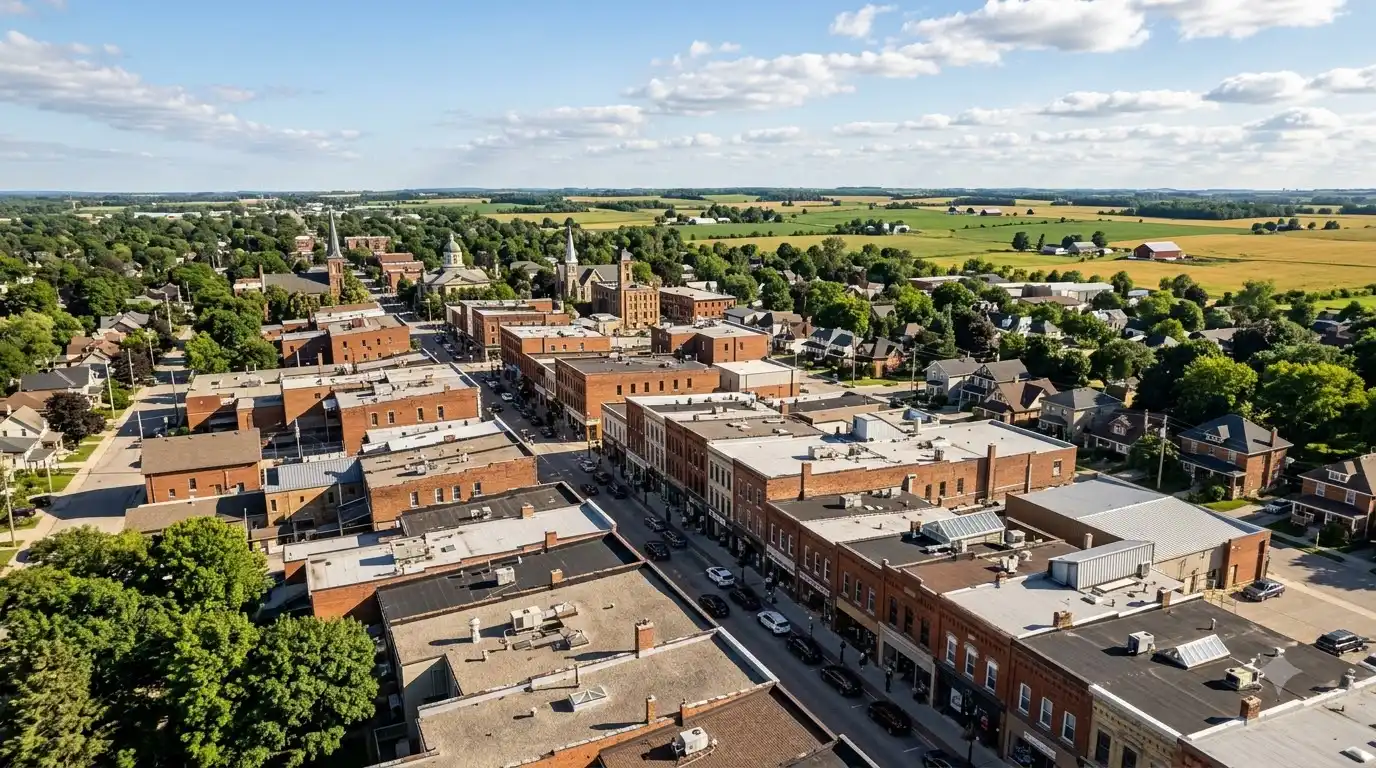
Work in St. Thomas extends to commercial and institutional properties in the St. Thomas Mega Site and PowerCo supply-chain area, the municipal industrial park, the Highbury Avenue corridor, Downtown St. Thomas and other industrial and commercial locations.
- Employment & commercial districts
- St. Thomas Mega Site and PowerCo gigafactory area · St. Thomas industrial park · Highbury Avenue commercial corridor · Downtown commercial core · Edgeware Road industrial area · new industrial area · South London Industrial Park (11884 Sunset Road)
- Neighbourhoods & nearby communities
- Downtown St. Thomas · Elgin Mall area · Port Stanley Road corridor
St. Thomas Roof Questions From New-Build and Established Facility Owners
We're in the supply chain for the new PowerCo facility. Our building is under construction. When should we do the first roof inspection?
As soon as possible after occupancy and before production equipment and utilities begin adding penetrations. The first inspection establishes what the roof looks like in its original commissioned state, every drain, every penetration for utilities, every curb, photographed from reference points that future contractors can return to. Without that baseline, the first time a contractor adds a conduit or an HVAC unit, there's no clean record of what existed before. The inspection itself is straightforward; its value compounds over the building's life.
Can a St. Thomas manufacturing plant replace its roof while maintaining production?
Usually yes, provided the project is organized around production rather than around roofing convenience. The key planning items are: identifying which interior areas are most sensitive to weather exposure, vibration or particulates from roofing work; dividing the roof into sections that can be completed to a watertight condition each day; ensuring dock access and material movement remain uninterrupted; and communicating work zone changes to plant management before each shift. Some roofing methods are better suited to operating facilities than others, that's a legitimate factor in the system specification.
Our St. Thomas industrial building has a section of roof over a production area that's been repaired three times in four years. What's actually happening?
Three repairs in four years on the same section is diagnostic information, not just bad luck. Either the repairs haven't addressed the actual failure mechanism, which means the water path was never fully traced, or there's a systematic problem with the assembly in that section, such as wet insulation that prevents flashing from adhering properly, a structural settlement that's opening seams, or ongoing damage from a production process below. The next step is a more thorough investigation that includes probing the insulation and looking at what's happening below the membrane in that area, not another surface patch.
How does the St. Thomas Mega Site development affect roofing decisions for existing buildings nearby?
For buildings that are within the supply-chain cluster and likely to be occupied for a long time, it's generally a reason to invest properly in roof renewal rather than extend a failing assembly with repairs. A building that will be occupied for another twenty-five years because it's part of an active supply chain is a very different investment from one whose future is uncertain. For buildings whose future use is less clear, a roof condition assessment that identifies remaining life and immediate risks is more useful than a long-term renewal plan.
What should a St. Thomas property owner budget for roof maintenance on a large industrial building?
A reasonable maintenance budget accounts for two planned inspections per year, pre-winter and post-winter, plus contingency for post-storm or post-contractor visits, drain cleaning and minor flashing repairs. Beyond that, a capital reserve based on the remaining service life of each roof section is more useful than a single annual maintenance figure. The capital reserve analysis requires an honest condition assessment as its starting point. Without one, the number is a guess; with one, it's a defensible projection that supports both board decisions and insurance documentation.
What should owners near major new industrial sites in St. Thomas plan for?
Plan for busier trades, tighter schedules and higher demand for materials. Book assessments early and agree on start windows. Keep records of baseline conditions so changes over time are clear.
Commercial Roofing Across Elgin County and Southwestern Ontario
New Build or Thirty-Year-Old Plant, the St. Thomas Roof Record Comes First
Large new industrial areas and older commercial roofs are both active in St. Thomas. Share the address and the building's use, and we will help you plan.