
Whitby Commercial Roofing for Logistics and Retail Sites
Whitby's industrial and commercial landscape runs in two directions at once. South of Taunton Road, the established areas around Hopkins Street, Consumers Drive and the Thickson Road South corridor contain warehousing, distribution and service-industrial buildings, some now carrying multiple roof generations and long repair histories. For roof owners, the building you have determines the strategy: mature south-Whitby stock calls for condition-based diagnosis and phased planning, while newer north-Whitby properties need accurate documentation from the moment the building is handed over.
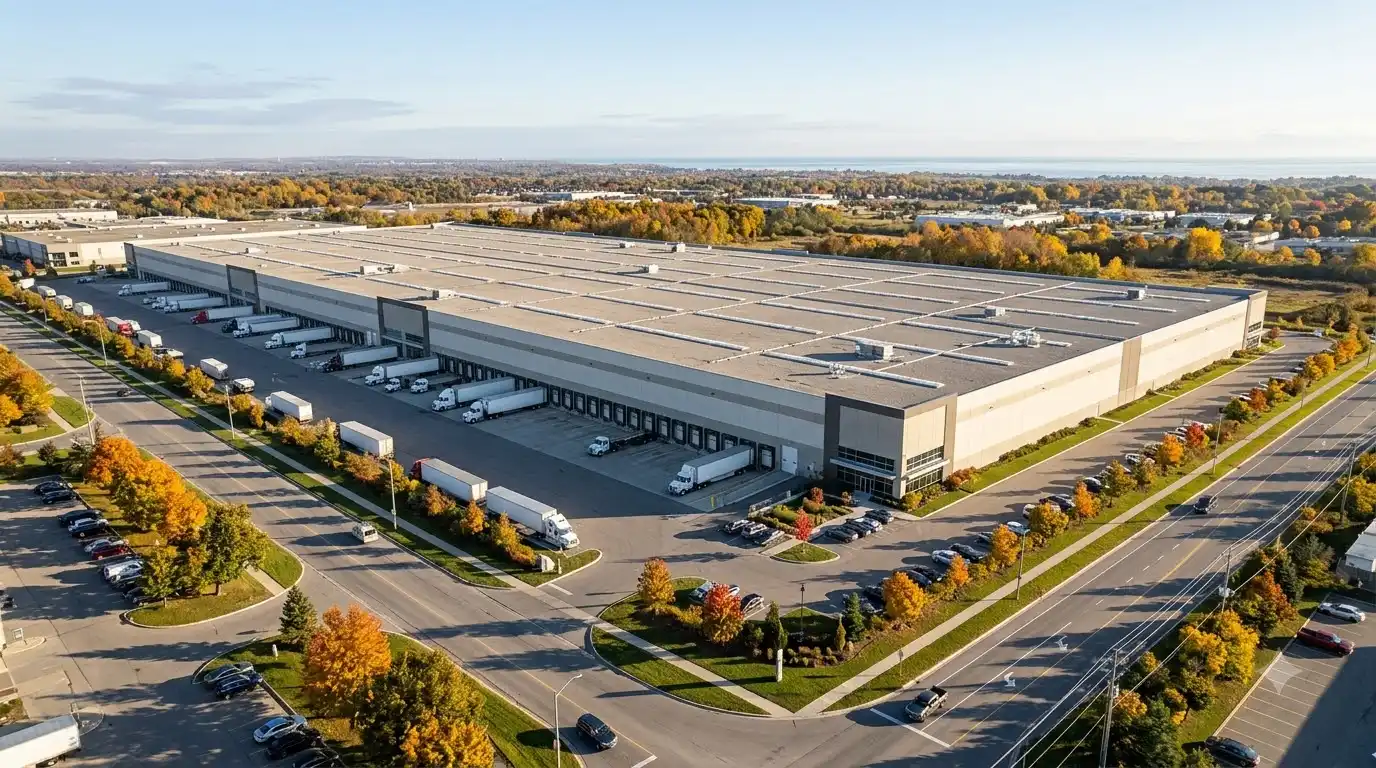
Whitby Roofing Strategy Depends on Which Generation of the Town's Industrial Market You Own
Established south-Whitby properties may include buildings added over different eras, with roof systems installed and repaired at various points. A single Hopkins Street address can contain TPO from a recent reroof over one bay, SBS from an earlier addition and original built-up over the original structure. Understanding which system covers which area, and which drainage basin serves each section, is the starting point for any diagnostic or replacement conversation. In the north, a new speculative building may have a pristine uniform roof today, but tenant equipment installations, communications upgrades and HVAC additions change that picture quickly.
For older south-Whitby and Port Whitby properties, the right approach is to map drainage basins, addition boundaries and roof ages, then overlay the repair history. Sections that have been repeatedly patched or where moisture has been found deserve closer attention than sections that are still performing well. For newer north-Whitby buildings in Brooklin, establish the starting record promptly: drain locations, equipment positions, walkway routes, warranty details and a rooftop access policy. Both approaches serve the same goal, a roof that is understandable to whoever manages the building next year and ten years from now.
Local reference: Town of Whitby economic development and investment opportunities
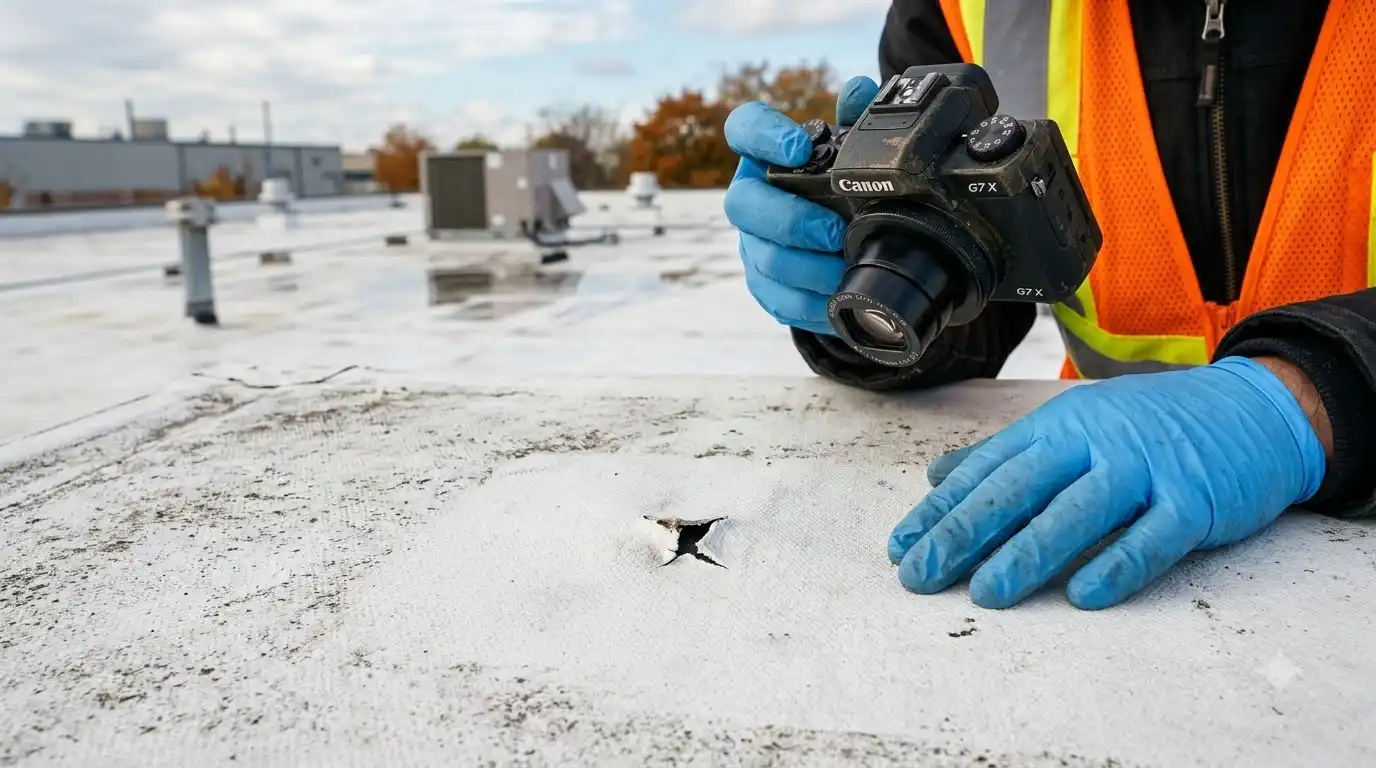
Whitby Commercial Roofing Services
For low-slope roof construction and membrane planning, see our commercial flat roofing guide.
Whitby Leak Investigation Should Start With the Roof Zone and Drainage Basin, Not the Ceiling Stain
A drip appearing inside a warehouse bay may be many metres from the point where water entered the roof assembly. In south Whitby, leaks on older roofs can travel along deck flutes, through saturated insulation or across addition transitions before appearing inside. Begin with the structural bay, the contributing drainage zone and recent weather, then inspect drains, seams, curbs, perimeters and transitions throughout that basin. On newer north-Whitby buildings, also review what changed recently on the roof, a new penetration, a service visit, a recently installed rooftop unit, before concluding that membrane age caused a problem that may be months old.
Hopkins Street and south Whitby warehouses
Track leak patterns against drainage basins and addition boundaries to distinguish recurring related defects from several unconnected deteriorating details.
North Whitby and Brooklin new builds
Review recent rooftop changes and post-trade conditions early, before multiple undocumented modifications obscure what the original roof actually looked like.
Mixed-age industrial facilities
Separate roof systems by section and installation era before deciding whether one deteriorated area should drive replacement of the entire building.
Select Whitby Roof Assemblies for Industrial Scale, Logistics Use and the Properties Being Built Now
Whitby's established industrial areas and newer growth corridors call for different roof strategies. Large logistics and distribution buildings amplify small design weaknesses: a drain sump that is slightly undersized, a perimeter edge that is inadequately fastened or a curb detail adequate for light traffic but not for weekly HVAC visits. Those details deserve as much attention as the membrane selection itself.
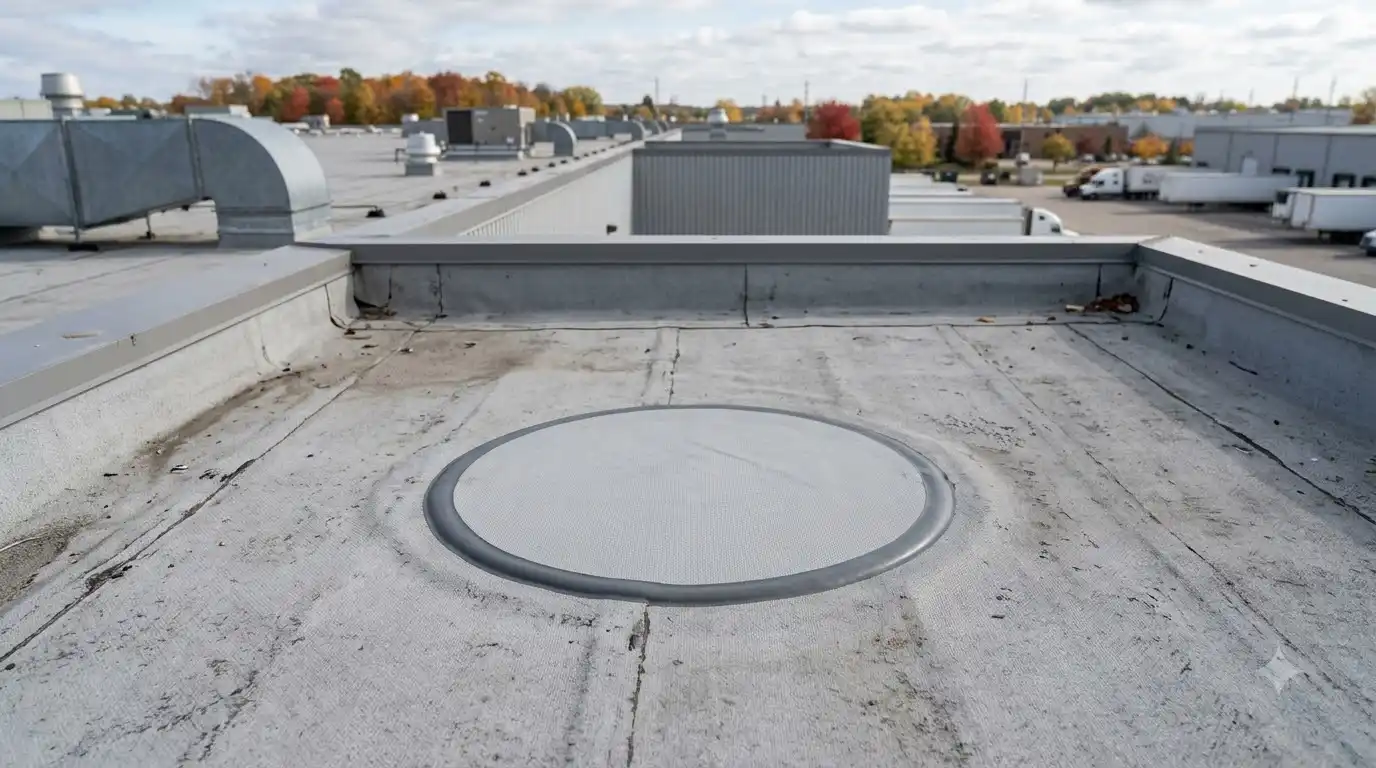
On newer north-Whitby industrial properties, plan for the rooftop's future from the start: service walkways, equipment clearances, solar-ready areas and logical phase-replacement boundaries. On established south-Whitby buildings, reroofing is the opportunity to remove abandoned penetrations, improve persistent low areas and rationalize the access routes that service contractors will use for years. The close-out package should be thorough enough that a new property manager can understand the complete roof without asking the contractor who built it.
Commercial Roofing SystemsPlanning Roofing Work Around Daily Operations
Plan Whitby Reroofing Around Docks, Shifts, Truck Circulation and Production Schedules
Whitby logistics and distribution buildings often have continuous truck movement, active dock operations and shift schedules that run around the clock. Before work begins, map dock locations, truck circulation routes, trailer staging, employee access, emergency lanes, roof-entry points and the areas needed for hoisting and material storage. Define working hours that avoid the facility's busiest periods and establish a daily weather-tight stopping point so operations are never left exposed by a roofing schedule that ran late. A construction plan that conflicts with the facility's logistics is more disruptive than the roof work itself.
Whitby Roof Programs Should Match the Building's Pace of Change
For an older south-Whitby warehouse, maintenance is about trend detection: comparing drain performance, flashing condition and repair frequency year over year to identify a section slowly becoming less reliable. For a newer north-Whitby building, maintenance is about change detection: confirming that each HVAC installation, communications upgrade or tenant modification was completed without membrane damage. Both approaches use the same seasonal inspection schedule, spring, fall, post-storm and post-trade, but the information they are looking for is different.
Sorting inspection notes by building age helps a Whitby owner compare older and newer roofs fairly.
Roof maintenance planningCommercial Roof Coverage from Hopkins Street and Consumers Drive industrial corridor to South Whitby industrial area
Roofing support in Whitby reaches commercial and institutional properties across Whitby, including the Hopkins Street and Consumers Drive industrial corridor, Port Whitby and south-Whitby industrial buildings, the Thickson Road North and Garrard Road growth area, Brooklin, Downtown Whitby and commercial properties with access to Highways 401, 407 and 412. For Whitby properties, the roof condition, drainage, access and building use still determine what work makes sense.
- Employment & commercial districts
- Hopkins Street and Consumers Drive industrial corridor · South Whitby industrial area · Thickson Road North and North Employment Area · Highway 407 and 412 industrial and commercial corridor · North industrial area · Thickson Road industrial and commercial corridor · Menkes Whitby Business Park (Stellar Drive)
- Neighbourhoods & nearby communities
- Port Whitby · Brooklin · Downtown Whitby
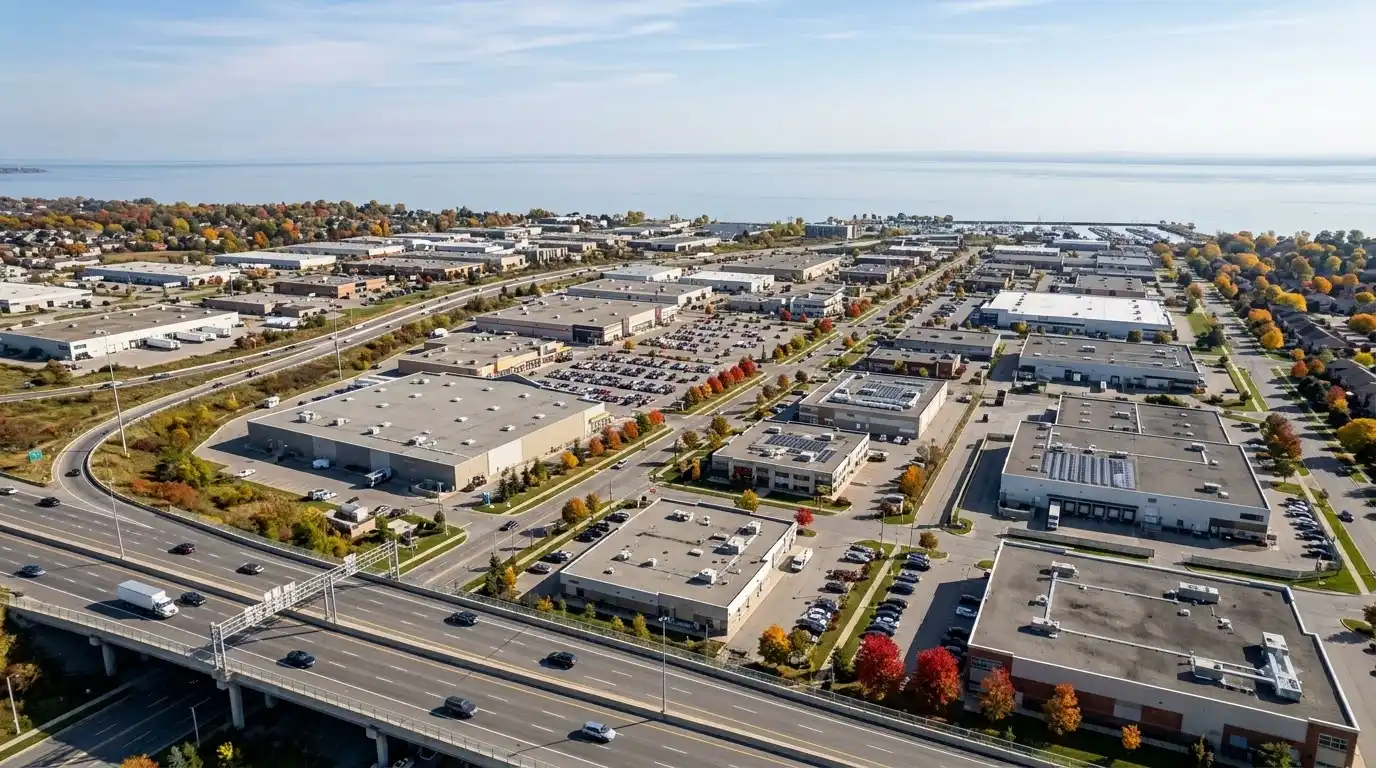
Whitby Roof Questions From Industrial and Logistics Owners
What is the most important roof record to establish on a new Brooklin industrial building before the first tenant moves in?
Get the drain and overflow locations, the roof-system specifications and close-out documentation, reference photographs from consistent viewpoints across the full roof, a plan showing every penetration and equipment position, and the warranty terms and contact information. Then create a simple rooftop access policy that requires future contractors to document new penetrations and the routes they used. New buildings accumulate undocumented rooftop modifications faster than most property managers expect, and the original condition is only easy to record once.
How do you find the source of a leak on a large south Whitby logistics building?
Begin inside: record the exact drip location, the structural bay, the weather that preceded the event and whether any rooftop work occurred recently. Take that location to the roof plan and identify the contributing drainage basin. Then inspect drains, seams, curbs, perimeter details and penetrations within that zone. Water on a large roof can travel a considerable distance inside the insulation before appearing inside; the visible stain is often not directly below the entry point. If the investigation suggests wet insulation extending well beyond the drain area, moisture testing can help define the scope before setting a repair boundary.
Can a Whitby warehouse be reroofed while full logistics operations continue?
Often yes, but the sequencing plan must be designed around the facility rather than the contractor's convenience. Identify dock locations, truck routes, employee access, fire lanes, crane positioning, debris-handling areas and the interior areas requiring protection. Establish clear daily opening limits and agree on weather contingencies before work begins. Coordinate with the logistics manager, not just the property manager. Some disruption is usually unavoidable, but a well-designed construction sequence can keep every dock operational throughout a phased replacement when both teams work from the same daily plan.
What should a property manager check after a Whitby industrial building's HVAC contractor installs a new rooftop unit?
Ask for photographs showing the curb installation before and after the membrane is flashed, confirmation that any penetration for conduit was properly detailed, and a record of the route the crew used. Verify that new walkway protection was placed over the travel path if the building does not already have one. A post-installation inspection shortly after the work is complete is far more useful than a complaint months later when water has already found the defect. It also establishes clear responsibility while both parties can still examine the work.
How should a Whitby property owner plan roof spending on a building that contains three different roof generations?
Assess each section separately: moisture, drainage performance, membrane and flashing condition, repair history and the consequence if water enters the interior area below. Then estimate which section is closest to the end of reliable service and whether continuing to repair it is more or less cost-effective than replacing it. Often the smartest plan is to replace the section consuming the most maintenance while preserving the others until they reach the same threshold. This produces a renewal schedule based on evidence rather than a single replacement date for the whole building.
How do Whitby owners compare older and newer building roof needs?
Older roofs often need condition surveys and replacement planning, while newer ones need baseline records and maintenance. Ask for a plan that treats each separately.
We Also Serve Ajax, Oshawa, Pickering and Port Perry
Tell Us Whether the Whitby Roof Is New, Aging or Somewhere Between
Established industrial roofs and newer Brooklin buildings differ widely. Tell us which you own and we will help you plan.