
St. Catharines Commercial Roofing for Niagara Buildings
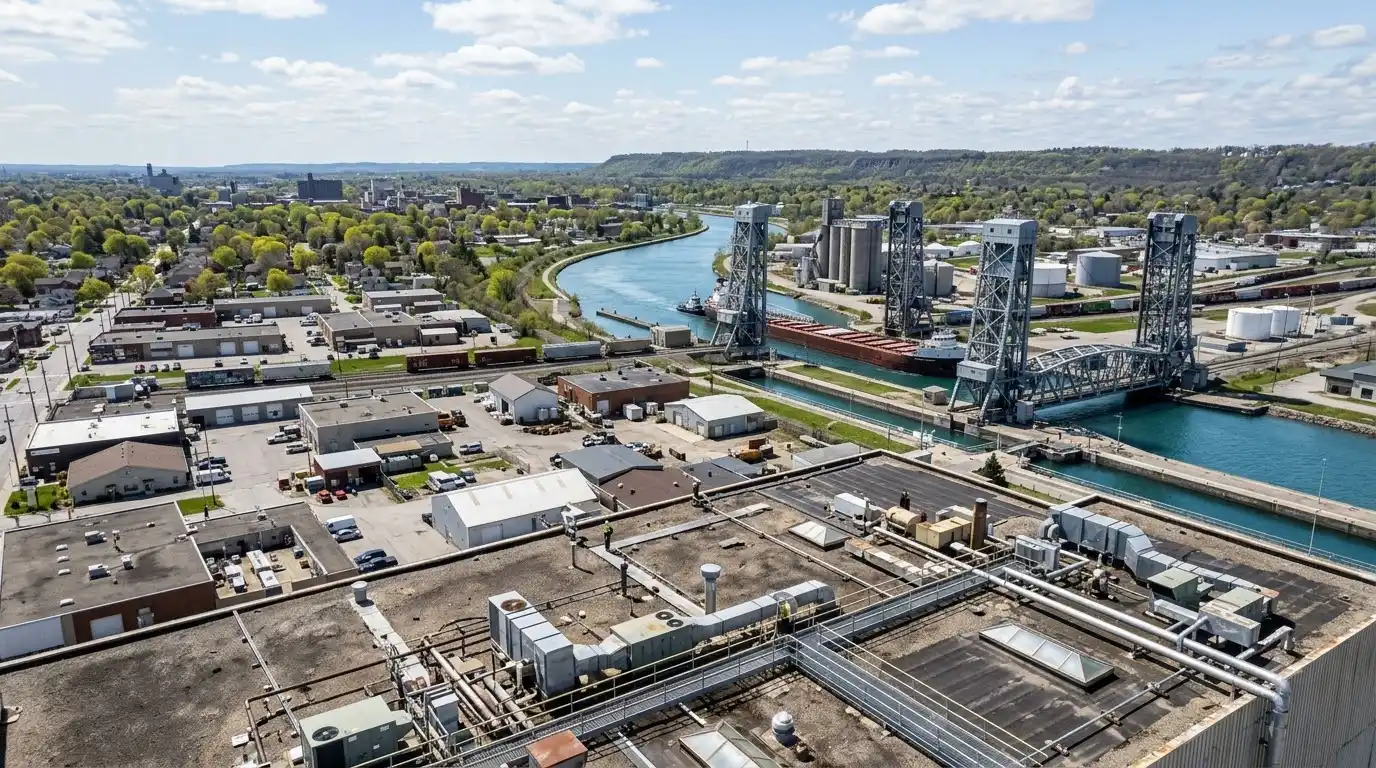
St. Catharines is Niagara's largest city and a regional manufacturing and commercial centre. Walker Road, Bunting Road and the QEW corridor anchor the city's established industrial base. General Motors' St. Catharines plant remains one of North America's largest powertrain facilities, while ENERCON is investing in a new wind-energy manufacturing centre along the Welland Canal, alongside metal fabrication, food processing and warehousing operations.

St. Catharines Industrial Roofs Are Older Than Many Owners Realize
The Walker Road and Bunting Road industrial corridors contain buildings from the 1970s, 1980s and 1990s that are now entering their most critical decision period, a second or third reroofing cycle where the cost of getting the assembly wrong is significantly higher because underlying deck and insulation conditions have been accumulating wear for decades. An owner who hasn't commissioned a formal condition assessment in the last five years may be making maintenance decisions based on how the surface looks rather than on what the structure and insulation beneath it actually reflect.
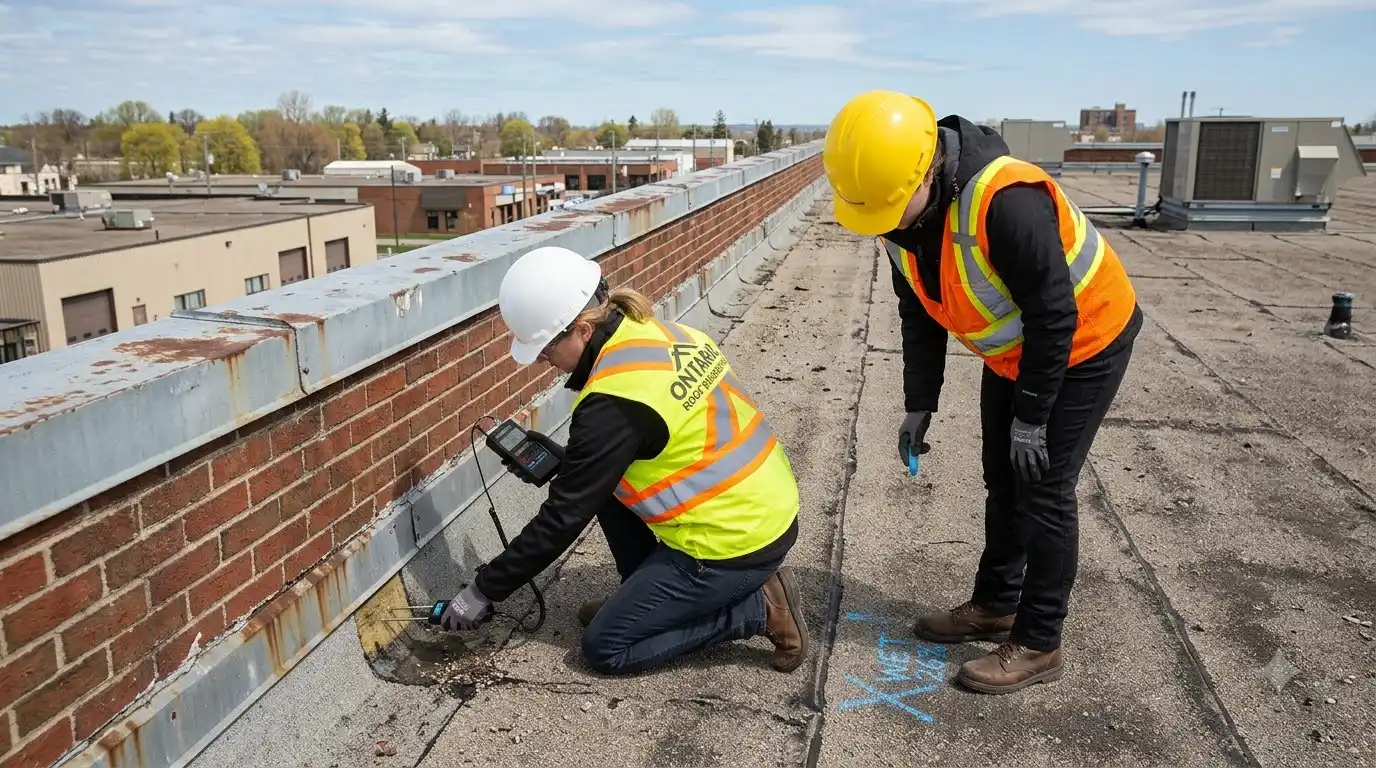
For a St. Catharines manufacturing or warehouse building that hasn't been formally assessed, the most useful first step is a condition survey organized by section. That survey should look at the membrane and flashings, probe for wet insulation, assess drain condition and document the penetration inventory. The findings often reveal that some sections of a building are ready for repair while others are approaching replacement, which means a better-informed capital plan rather than a crisis decision driven by the next significant leak.
Local reference: City of St. Catharines economic development and employment area information
St. Catharines Commercial Roofing Services
For low-slope roof construction and membrane planning, see our commercial flat roofing guide.
Wind Exposure Shapes Where Leak Problems Show Up on St. Catharines Roofs
Lake Ontario and the Escarpment create wind patterns that can concentrate wear on specific roof perimeters, typically the north and west edges on buildings without sheltering. On St. Catharines industrial and commercial roofs, recurring perimeter and coping problems often point to wind uplift stresses that ordinary precipitation analysis wouldn't predict. When a building keeps losing flashings or edge metal in the same area, the direction of weather and the local exposure deserve as much attention as the membrane condition itself.
Walker Road and QEW industrial buildings
Divide large manufacturing and warehouse roofs into drainage sections before investigating leaks, water can travel far from its entry point in a multi-span industrial building.
Bunting Road commercial corridor
Track HVAC service history and equipment changes on multi-tenant commercial and industrial buildings so future leak investigations have a contractor log to work from.
Downtown and institutional properties
Include wall and parapet conditions in leak investigations on older St. Catharines buildings where vertical fabric may be contributing water above membrane level.
Match St. Catharines Roof Assemblies to Wind Exposure, Manufacturing Load and Occupancy
In St. Catharines, industrial corridors and downtown properties need quite different assemblies. What matters is the complete assembly: deck condition, insulation type and thickness, vapour control, attachment method, drainage geometry, perimeter and edge design and the building's actual use. A food-processing facility has different requirements from a metal fabrication shop, which has different requirements from a multi-tenant commercial building on Bunting Road. The wind design for a perimeter-exposed QEW-adjacent building also deserves explicit attention.

Replacement should address the problems the previous roof documented. Remove abandoned penetrations, rebuild curbs that were improvised rather than engineered, correct drain sumps and sill transitions and establish walkway routes to equipment that will be serviced regularly. On manufacturing properties where the interior generates significant heat or humidity, vapour control deserves particular attention, a poorly designed vapour barrier in a St. Catharines food plant or automotive facility can cause moisture problems that appear at the membrane but originate from within the assembly.
Commercial Roofing SystemsPlanning Roofing Work Around Daily Operations
Plan St. Catharines Reroofing Around Manufacturing Schedules, Dock Access and Tenant Operations
Many St. Catharines manufacturing and industrial properties run continuous or near-continuous operations. A roof replacement that doesn't account for shift schedules, production equipment below the work area, loading dock access and air intake locations will create conflict that could have been avoided with a clearer pre-project plan. The project's daily watertight limits, hoisting positions, staging area and communication plan with plant management belong in the contract scope, not in a verbal understanding that may change as the work proceeds.
Consistent Pre-Winter Preparation Is the Most Valuable Maintenance Investment in St. Catharines
Niagara winters combine freeze-thaw cycling with wind and periodic heavy snow. Drain screens that are partially blocked in October may be completely blocked by February, and a blocked drain in a Niagara winter can hold water against flashings for extended periods. Pre-winter maintenance, drain cleaning, flashing check, coping inspection, perimeter edge review, is more valuable per dollar spent than any other routine maintenance action on a St. Catharines commercial roof. Add a spring review after thaw and a post-contractor inspection whenever rooftop work has occurred and you have a maintenance program that catches most problems before they reach the ceiling.
Dividing a St. Catharines roof into numbered areas and logging events against them reveals which area keeps causing trouble.
Roof maintenance planningSt. Catharines Commercial Roof Coverage: Walker Road industrial corridor, Bunting Road commercial and industrial area and Local Business Properties
Our St. Catharines service area covers commercial and institutional properties along Walker Road, Bunting Road, the QEW industrial corridor, Downtown St. Catharines, the Seaway and Port Weller areas and other business and institutional locations across the city.
- Employment & commercial districts
- Walker Road industrial corridor · Bunting Road commercial and industrial area · QEW industrial corridor · Downtown St. Catharines commercial core · general industrial districts and business parks
- Neighbourhoods & nearby communities
- Downtown St. Catharines · Port Weller · Merritton · Glendale
St. Catharines Roof Questions From Owners and Plant Managers
We manufacture food products on Walker Road and need the roof replaced. How do we prevent production disruption?
The project plan needs to address three specific things: air intakes (roof membrane work can produce odours and particulates that must not enter the production environment, so intake locations need to be mapped and the work sequenced away from them); structural deck loading (membrane and insulation delivery should not concentrate weight above active production equipment); and daily watertight closure (no section of the roof that sits above active production space should be left open at the end of a shift). If a particular detail or sequence requires a brief shutdown of an adjacent production line, that should be planned in advance rather than discovered mid-project.
Our Bunting Road commercial building has had the same EPDM roof for 22 years. Is that too old to repair rather than replace?
Age alone doesn't determine the answer. A 22-year-old EPDM roof that has been consistently maintained, has dry insulation and shows deterioration only at specific details is a reasonable candidate for targeted repairs that extend its useful life. One that has widespread surface cracking, multiple moisture pockets and a repair history scattered across every drainage zone has reached the point where continued patching is less reliable and cost-effective than a planned replacement. The right answer requires a current condition assessment, not an assumption based on the calendar.
Can St. Catharines commercial roof projects be affected by Niagara's wind exposure in ways that aren't obvious during an inspection?
Yes. Wind uplift at perimeters and corners is the most common issue, edge flashings and coping sections that look fine on a calm day may show movement or failure after a sustained wind event from a consistent direction. Buildings with long unobstructed elevations facing Lake Ontario or positioned at the top of the Escarpment slope deserve particular attention at the north and west perimeters. The inspection should note local exposure and compare it against the perimeter and edge details that are in place, not every detail designed for a sheltered southern Ontario commercial building performs equally well in a Niagara exposure.
We have an older institutional building near downtown St. Catharines where the flat roof leaks during freeze-thaw periods. What causes this?
Freeze-thaw cycling creates two related mechanisms. First, water that has infiltrated cracks in coping, masonry or flashings expands as it freezes, widening the opening and allowing more water to enter during the next thaw. Second, meltwater running from a snow-covered roof can refreeze at the perimeter before reaching the drain, creating an ice dam that holds water against flashings at a level they weren't designed for. On an older institutional building, both mechanisms are likely contributing. Inspect copings, parapet faces, counterflashing edges and drain surrounds after a freeze-thaw event rather than during a dry period.
What should a St. Catharines commercial property owner record when a rooftop HVAC unit is replaced?
At minimum: the date, the contractor, the existing curb condition before work began, whether the old curb was reused or replaced, photographs before and after the installation, and a note of the travel route used to move equipment across the roof. Confirm the drain nearest to the work area is clear of debris and that the membrane around the curb base wasn't damaged during equipment movement. That record can resolve a dispute quickly if a leak appears six months later near the new unit, and it establishes accountability that protects both the owner and the HVAC contractor.
How do I plan roof work on a downtown St. Catharines building?
Check access, adjacent buildings, parapets and drainage first. Ask the roofer how materials will reach the roof and how pedestrians will be protected. Confirm any approvals that could apply.
Commercial Roofing Across Niagara
Send Us the St. Catharines Building and Its Roof History
Industrial and downtown roofs in St. Catharines vary widely. Tell us which you own and what is going on, and we will help you choose a first step.