
Alliston Commercial Roofing for Working Facilities
Alliston's Industrial Parkway corridor supports auto assembly, parts suppliers, logistics and other commercial operations, while its downtown has older low-slope roofs with layered repair histories. Industrial facilities need leak-control plans that respect production and operating schedules. Downtown properties often need careful investigation of older assemblies, additions and drainage before an owner decides whether to repair or replace.
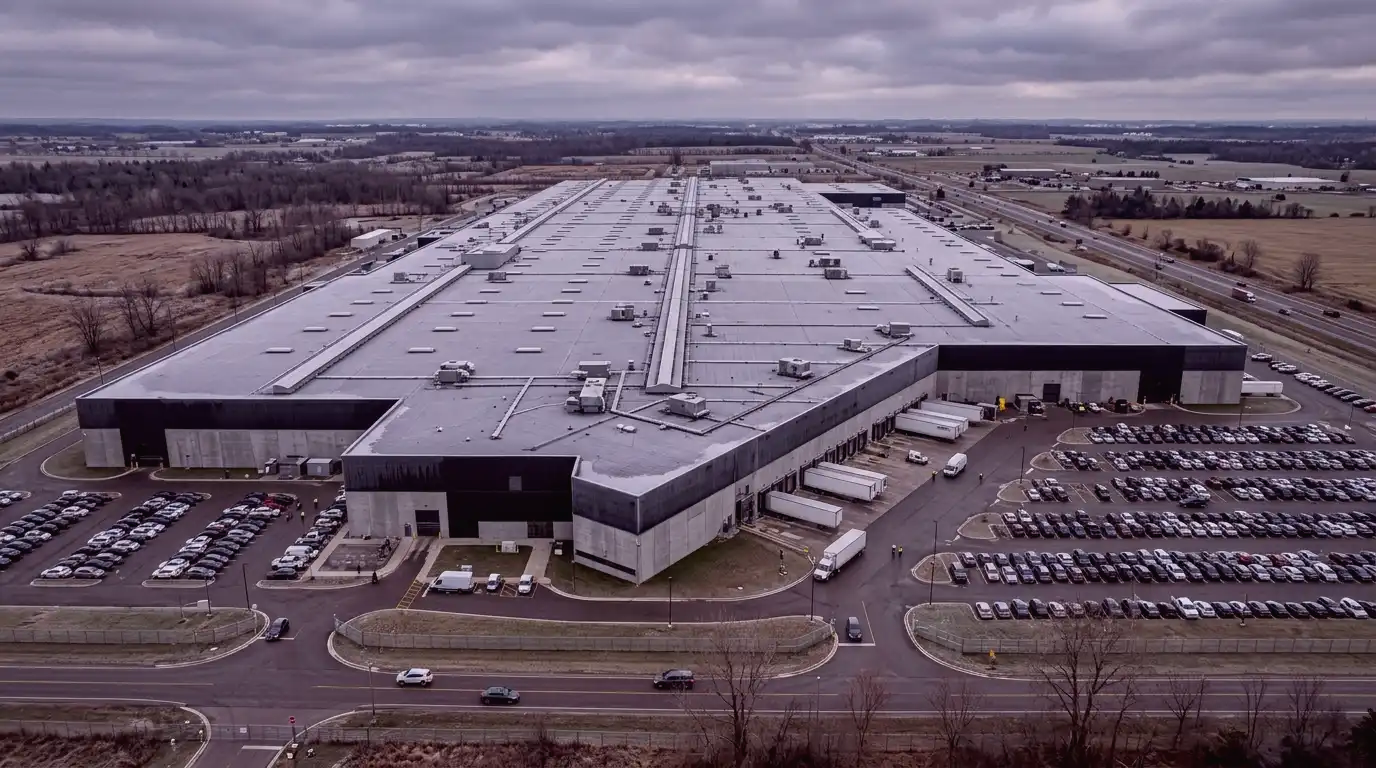
Roofing Along Industrial Parkway and Victoria Street
The Industrial Parkway corridor carries Alliston's largest buildings: auto assembly, parts manufacturing, warehousing and logistics operations with broad, largely unobstructed roof fields. Roof problems here are not slow-moving budget items. A failed drain or a growing wet zone in the insulation above an assembly line, a paint process or an electrical distribution room is a production risk. These buildings also receive regular rooftop trade work for HVAC maintenance and process equipment, which means penetration management and post-trade roof checks are a standard part of facility management, not an occasional response to a problem. Alliston also has a large Health Canada-regulated medical-products manufacturing plant producing intravenous and dialysis solutions. Roofing work above a regulated production environment can require tighter dust and debris control, restricted-access sequencing and coordination with the facility's own quality and compliance procedures, so the project plan should be built around the actual operating requirements of the facility rather than treated like a standard warehouse roof.
Victoria Street and the King Street commercial area tell a different story. These are downtown commercial buildings: retail ground floors with offices or apartments above, older flat-roofed blocks that were built, modified and re-roofed in segments across several decades. A roof on a downtown Alliston property may span two or three different membrane systems without any record of when each was installed. A leak in one area can have its cause in an adjacent section, and confirming which era of roofing is actually failing, and what happens to the connection to the next section if one part is replaced, is the starting point for any informed decision.
Local reference: Honda of Canada Mfg. Alliston facilities information and New Tecumseth town profile
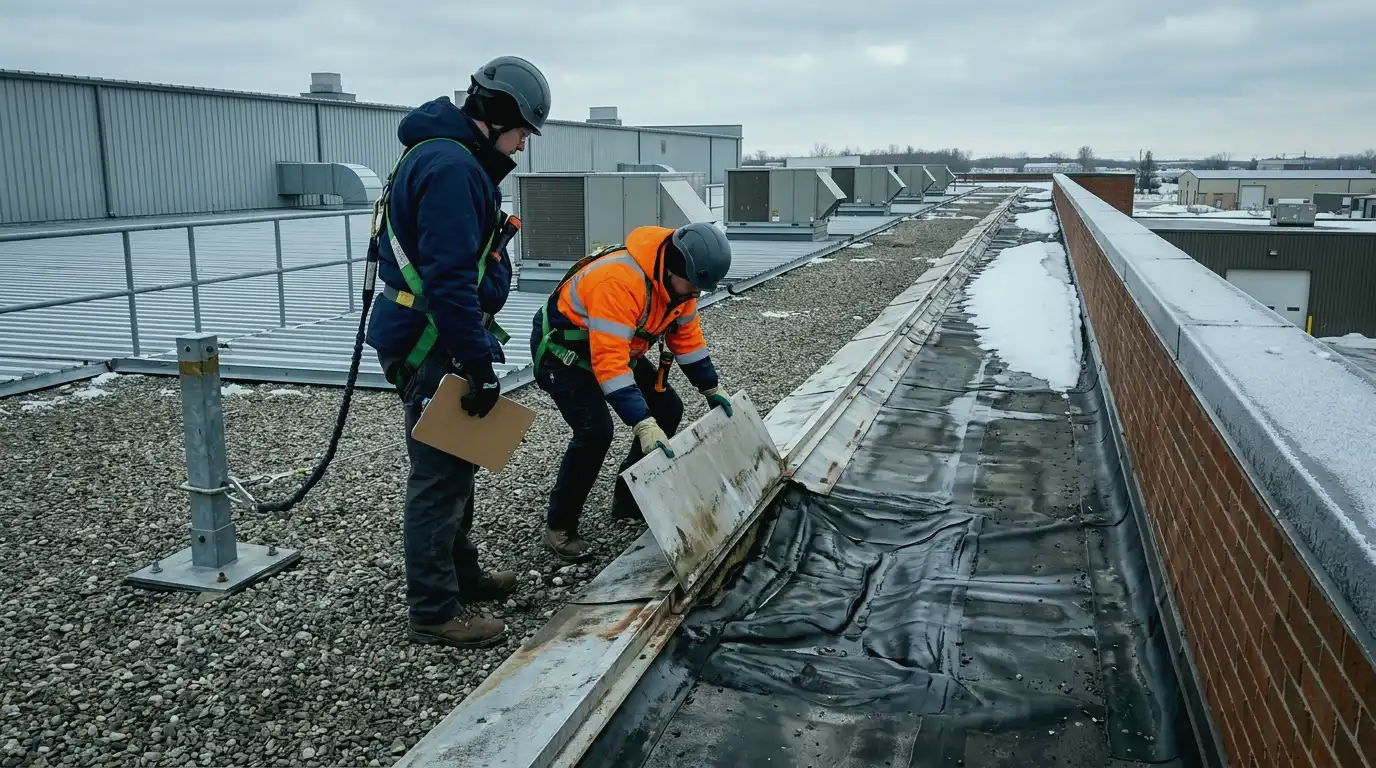
Alliston Commercial Roofing Services
For low-slope roof construction and membrane planning, see our commercial flat roofing guide.
Trace the Leak to Its Roof Source
Alliston's manufacturing buildings and older downtown stock present different diagnostic challenges, but they share this: the interior drip is rarely the complete story. In a production facility, water can travel along steel purlins, along insulation seams or through mechanical openings before it appears at the ceiling. In a multi-era downtown building, it can cross section boundaries and appear several bays away from where it entered the roof. The investigation needs to start with a roof map, drainage paths, section boundaries, repair history and current detail conditions, before any repair scope is agreed.
Watch drains and scuppers at the end of Simcoe County winters
Alliston receives meaningful snowfall each winter, and the first warm stretch in late February or March can leave drains partially blocked by debris and ice simultaneously. Checking drain flow, scupper clearance and any low points where meltwater tends to pool before the spring rain season begins can catch problems while they are still minor.
Check curbs and penetrations after every significant HVAC service visit
Industrial Parkway facilities carry rooftop mechanical equipment that is serviced year-round. Each visit brings additional traffic, and curb flashings, pitch pockets and conduit penetrations can be disturbed without anyone flagging it to the building operator. A roof walkthrough after major mechanical work helps document the affected details and identify damage before it becomes an active leak.
Identify the specific section before agreeing on any repair scope
A Victoria Street or King Street commercial building may carry two or three different roof assemblies under one address. Before any repair scope is set, confirm which section contains the failure, whether adjacent transitions are intact, and whether the cause lies in the membrane field, at a detail, or at the connection between eras of roofing.
Choosing Roof Systems for Alliston Properties
A production environment above automotive assembly or parts manufacturing puts specific demands on a roofing system. Reliability is the primary requirement. Any leak that reaches a paint process, a precision assembly area, an electrical room or climate-controlled storage has immediate operational consequences that go well beyond the repair cost. That should shift the conversation toward systems with a documented track record of seam integrity and honest maintenance requirements, not toward the lowest material cost per square foot. Whether the answer is TPO, PVC, EPDM, SBS modified bitumen or a built-up assembly depends on the deck type, insulation strategy, HVAC density, expected service traffic and how future mechanical or building changes will interact with the roof.

For downtown Alliston properties, system selection often comes down to what can be installed within the available access and staging conditions, how the new assembly will connect to adjacent walls or roof sections, and what the tenant mix requires in terms of interior protection during the work. Alliston's location in Simcoe County also means the selected system needs to perform reliably through snow loads that are meaningfully higher than most GTA benchmarks, not just occasional heavy storms, but the sustained accumulation and melt cycles that are a routine part of winters north of Highway 400.
Commercial Roofing SystemsPlanning Roofing Work Around Daily Operations
Keeping Businesses Open During Roof Work
Roofing work on an active Alliston manufacturing building requires a project plan built around operations, not around the roofing crew's schedule. Identify production areas that cannot tolerate water risk or vibration, locate any equipment shutdowns required for safe crane or hoist access, confirm delivery windows and site perimeter access, and establish waterproof stopping points that can be reached in a defined number of working hours. At a downtown property, add tenant communication, pedestrian clearance, neighbour-wall considerations and constrained material staging to the same conversation. The work should proceed in segments the building can safely absorb, not in the sequence that happens to be fastest for the crew.
Plan Inspections Around Roof Conditions
A twice-yearly maintenance program tuned to Alliston's calendar should check drains and scuppers before freeze-up in late autumn and again after the melt in April. Between those visits, the log should record any rooftop trade work, any interior leak events and any areas that have been repaired. On a production facility along Industrial Parkway, the log should use the same section labels as the roof plan so that maintenance calls, HVAC work orders and capital budget discussions reference the same geography. The goal is to know which sections are performing reliably, which are changing, and what the likely sequence of future repairs or replacements looks like, before a leak event forces the decision under pressure.
For an Alliston plant or supplier building, keeping one record of leaks, equipment changes and past patches stops each new problem being treated as the first.
Roof maintenance planningServing Alliston's Commercial Districts
Alliston owners can call on us for manufacturing and industrial properties along the Industrial Parkway corridor, supplier and logistics operations throughout New Tecumseth, downtown Alliston commercial properties on Victoria Street and King Street, and institutional and commercial buildings along the Highway 89 corridor. Across Alliston, we look at the actual roof, drainage and day-to-day building use before recommending repair or replacement.
- Employment & commercial districts
- Industrial Parkway industrial corridor · Highway 89 commercial corridor · Downtown Alliston BIA · Baxter Canada medical-products manufacturing plant
- Neighbourhoods & nearby communities
- Downtown Alliston · Victoria Street · King Street · Young Street · Highway 89 corridor
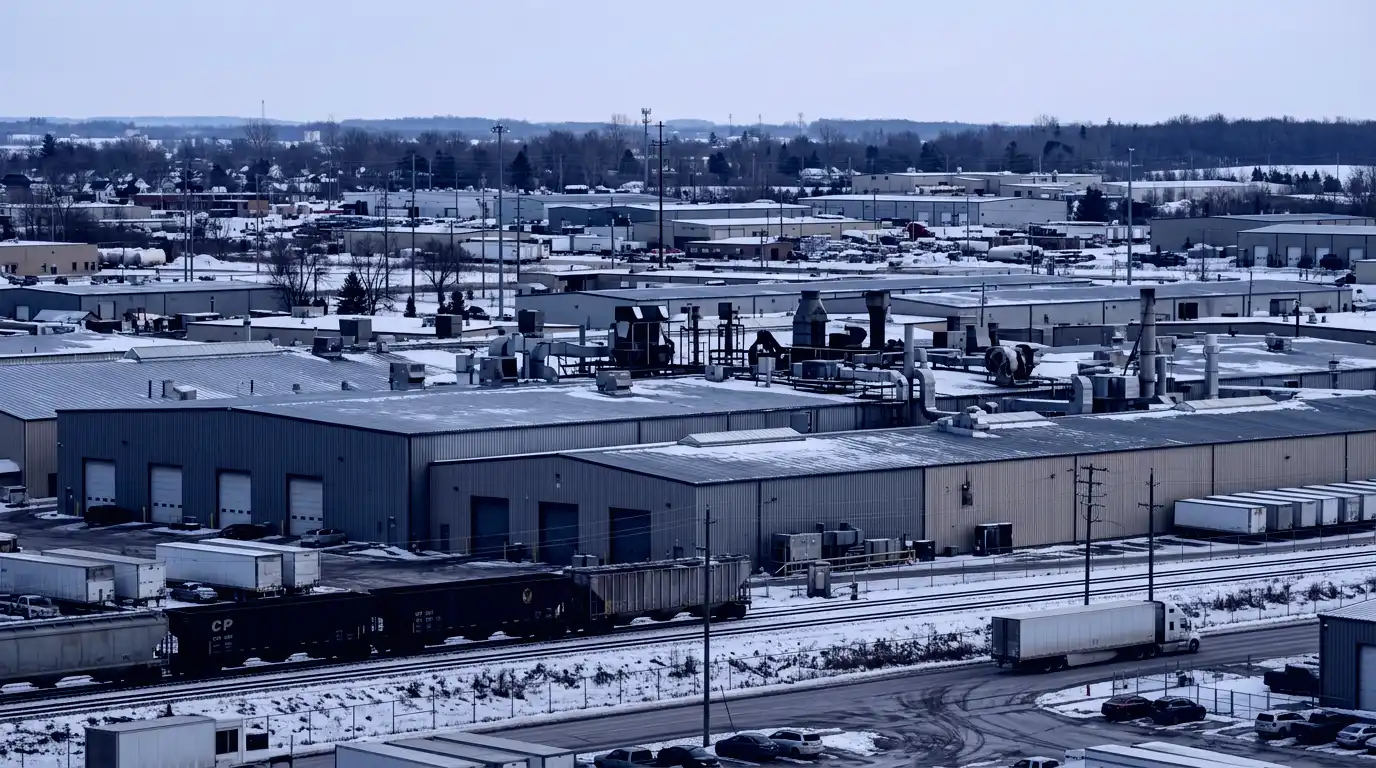
Roofing Questions From Alliston Plant and Property Managers
Why does a production facility in Alliston face higher consequences from a flat roof leak than most commercial buildings?
When water enters a retail space or office, the consequences are property damage, disruption and a repair invoice. When water enters a paint booth, a precision parts-manufacturing area, an electrical distribution room or an automotive assembly line, the consequences can include halted production, rejected product, equipment damage and safety risks. That shifts the roofing calculus considerably. A production building near Industrial Parkway has a stronger case for proactive annual inspections, conservative repair standards and earlier replacement consideration than a building where a contained leak can be managed without shutting down the operation below it. The cost of a roof that lets water in is rarely just a roofing cost in a manufacturing environment.
How much more snow load should an Alliston building owner plan for compared to a GTA property?
Alliston sits in Simcoe County, north of the Greater Toronto Area's urban heat influence. While it does not see the extreme lake-effect accumulations of the Barrie-to-Collingwood snowbelt, it reliably receives meaningfully more snow than Durham Region or the 905 belt south of the Oak Ridges Moraine. The Ontario Building Code references specific ground snow load values by municipality through the supplementary climatic data tables, and the design figure for Alliston is higher than most GTA values. This matters practically for flat-roof drainage design: a drainage system sized for a Toronto or Mississauga reference may allow significant ponding on the same building footprint in Alliston during a sustained winter accumulation followed by a warming event. If you are moving equipment or operations from a GTA facility, or comparing drainage design to a southern Ontario reference, Alliston's snow context is worth understanding on its own terms rather than assuming the conditions are equivalent.
Can commercial roofing work be scheduled around a planned production shutdown at an Alliston plant?
Yes, and production shutdowns are actually useful anchors for roofing project planning. They are typically scheduled well in advance, which allows procurement, crew scheduling and staging logistics to align with the available window. Coordinating a larger scope of work, replacement of a section above an assembly line, major HVAC coordination, insulation replacement, around a scheduled shutdown can avoid working above active production, simplify interior protection, and allow the completed roof to be inspected before the line returns. The practical requirement is that the scope and materials be confirmed well before the shutdown window so nothing delays the crew once access opens. Treating the shutdown as the fixed constraint, rather than fitting roofing around the production calendar on the fly, produces a cleaner, lower-risk result.
My downtown Alliston commercial building has had multiple contractors work on the roof over the years. Where do I start?
Start with a condition assessment that documents the roof as it is today, not as it was planned or claimed to be. A thorough inspection walks every section, identifies membrane types and ages, probes for wet insulation at transitions and low spots, documents drain and scupper conditions, and records what repairs have been done and where. That gives you a clear picture of what each section looks like now, which transitions between different systems are intact, and where the most likely failure risks are located. Without that map, any quote for work is essentially guesswork, you risk replacing sections that did not need it while leaving the actual problem in place, or repairing one section in a way that stresses the connection to the adjacent one.
Should the roof be assessed before committing to a building addition or second-storey expansion in Alliston?
An early roof assessment is strongly advisable before any addition or expansion is designed. If the existing roof will be removed, modified or connected to new construction, understanding its current condition, drainage configuration and moisture content matters before design decisions are made. Water trapped in insulation above a roof-to-wall connection, for example, needs to be addressed before new construction closes over it, or it becomes a hidden moisture problem that resurfaces in the new assembly later. An early assessment also helps the design team understand the existing drainage logic, parapet heights and structural constraints before committing to an addition layout that may conflict with them.
How should a manufacturer in Alliston budget for roof work around production schedules?
Build the roof into the same planning cycle as equipment shutdowns and model changeovers. Ask for a phased scope and a defined start window, so that tear-off areas are limited to what can be dried in each day. Budget separately for interior protection over sensitive lines and for any deck repair found once the membrane is open.
Commercial Roofing Across the Rest of South Simcoe
Start With the Alliston Roof You Actually Have
Tell us which Alliston building this is, what it produces or houses, and what you have seen on the roof or inside. We will help decide whether the next step is a repair, a core review or a replacement scope.