
Georgetown Commercial Roofing: Repair and Drainage Planning
Georgetown's commercial and industrial geography is spread across several distinct areas within Halton Hills. The primary industrial concentration runs north of Guelph Street and east of Mountainview Road, an established area of manufacturing, service-industrial and warehouse buildings that includes properties assembled over multiple decades. Smaller industrial pockets near Sinclair Avenue, Delrex Boulevard and River Drive add to the inventory.
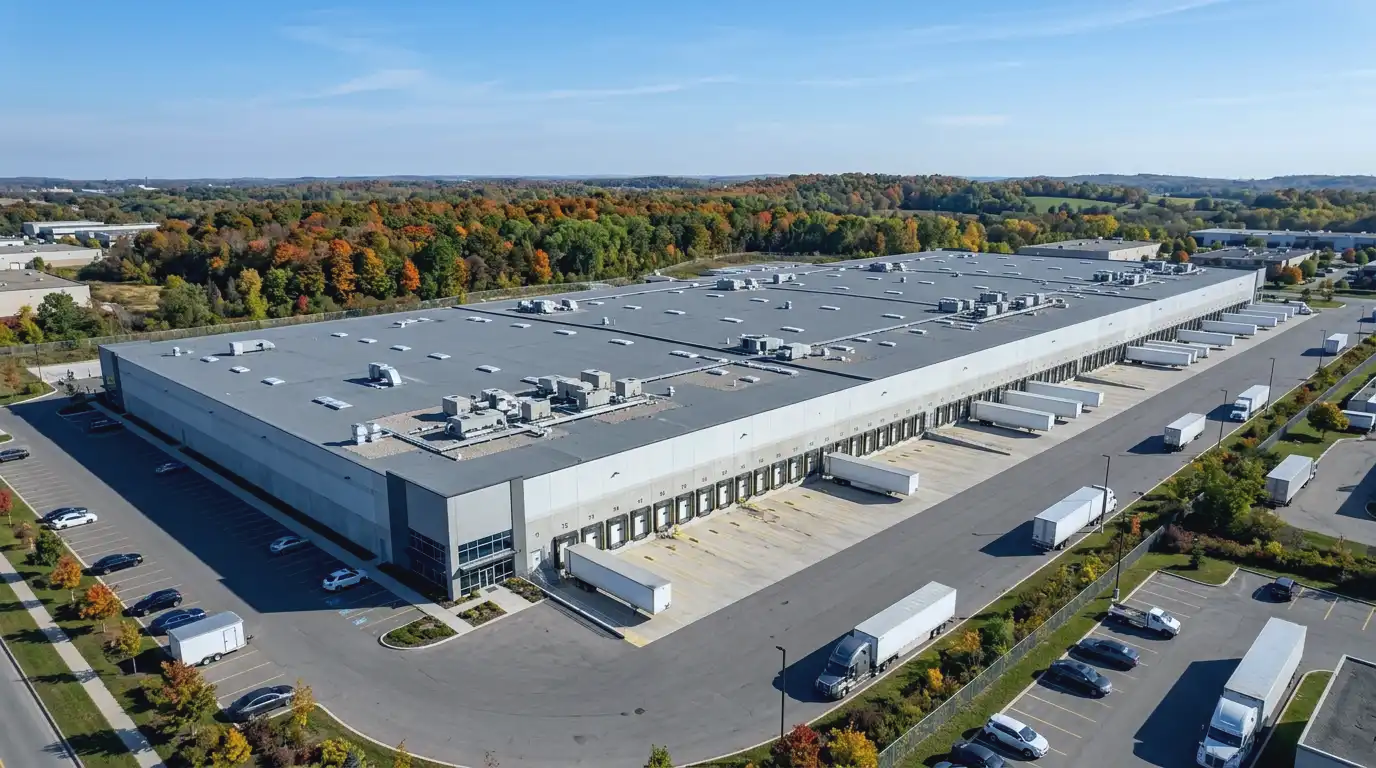
Industrial and Downtown Roofs in Georgetown
The Guelph Street industrial area includes properties that have been operating and expanding over decades. Buildings with additions from different periods can have multiple roof sections at different heights, with drainage designed to each addition rather than to the building as a whole. On those properties, a leak in one section may not be diagnosable without a section map that identifies which drain and which drainage basin covers the affected interior area.
Georgetown's downtown commercial buildings sit closer to the street, with shared walls, public sidewalks and less available staging ground. A parapet on a main-street building may also share a wall with the property next door, which means a leak near that shared wall could have its entry point at a location that the building owner can't access without negotiating access to the neighbouring property. Those complications need to be identified early in the investigation, not after materials have arrived.
Local reference: Town of Halton Hills Georgetown industrial and business-area information

Georgetown Commercial Roofing Services
For low-slope roof construction and membrane planning, see our commercial flat roofing guide.
Map the Roof Before Investigating Leaks
On a Georgetown building with multiple additions or roof levels, the first step is a section map: identify each distinct roof area, its approximate age if known, its drainage system and how it connects to adjacent sections. From that map, the interior leak location can be matched to the correct section and basin. Inspecting the wrong section, easy to do on a building where two different roofing contractors have worked at different times, wastes diagnostic time and can produce misleading conclusions about the overall roof condition.
Guelph Street mixed-age roof sections
Create a section map with drain numbers and section boundaries before investigating leaks on older Georgetown industrial buildings. A repair in Section A may look similar to a repair in Section C, but the membrane type, age and condition may be completely different.
Downtown parapet and wall interfaces
Inspect coping, counterflashing and masonry interfaces on downtown Georgetown commercial buildings before focusing on the field membrane. Wind-driven rain leaks through walls account for a meaningful portion of what's misdiagnosed as flat-roof membrane failure.
Post-HVAC-work inspection
Inspect the travel path used by mechanical contractors when they move equipment across the membrane, not just the new curb itself. Dragged equipment and foot traffic to and from the access hatch are common damage sources that a new-curb inspection alone will miss.
Roof Systems for Georgetown Buildings
Industrial buildings on Guelph Street and Mountainview Road may have concrete, steel or wood-fibre decks depending on their construction period. Each deck type influences the appropriate insulation and membrane attachment method. Rooftop traffic levels also vary, a building with two HVAC units and one annual service visit has different wear patterns than one with a busy rooftop mechanical room serviced by multiple trades throughout the year. TPO, PVC, EPDM, SBS modified bitumen and built-up roofing each have appropriate applications in Georgetown; the selection should follow the building's actual conditions.

Downtown Georgetown commercial buildings often have older construction details, masonry parapets, wood-frame decks, parapet-only drainage, that influence which replacement options are practical. A new membrane that terminates correctly against the existing masonry and manages drainage without relying on scuppers in poor condition is worth more than a modern material specification that ignores the building it's being installed on.
Commercial Roofing SystemsPlanning Roofing Work Around Daily Operations
Roof Work Around Industrial and Main Street Sites
An industrial building on Guelph Street or Mountainview Road usually has loading access, yard space and room to position a crane or rooftop hoist without affecting operations significantly. A commercial property in Downtown Georgetown has a different set of constraints: customer parking, street-level retail, public sidewalks and often no private staging area beyond the front entrance. The difference matters in the planning stage, material quantities, delivery scheduling, debris removal and daily open-roof limits should be worked out against the specific site before the final work sequence is agreed.
Maintenance Records by Roof Section
A maintenance log that says 'repaired a seam near the north side' is almost useless on a building with three roof sections that each have a north edge. Number the drains, sketch the section boundaries, reference every repair and inspection photograph to those numbers, and store the records where the next property manager can find them. That file, even a simple one, is worth more than the most thorough inspection report without location references.
Georgetown owners benefit from tracking which tenant reports each leak and when the last HVAC visit was.
Roof maintenance planningServing Georgetown's Commercial Districts
Our Georgetown coverage spans industrial, commercial and institutional properties across the Georgetown industrial area, Guelph Street and Mountainview Road corridors, Sinclair Avenue, Delrex Boulevard, Downtown Georgetown and surrounding Halton Hills commercial areas. Across Georgetown, we look at the actual roof, drainage and day-to-day building use before recommending repair or replacement.
- Employment & commercial districts
- Georgetown Industrial Area north of Guelph Street · Guelph Street commercial and industrial corridor · Sinclair Avenue and Delrex Boulevard industrial areas · Mountainview Road and River Drive industrial areas · Georgetown Industrial Area · Guelph Street General industrial area · Sinclair Avenue industrial area
- Neighbourhoods & nearby communities
- Downtown Georgetown · Guelph Street · Mountainview Road

Georgetown and Halton Hills Roofing Questions
Why does my Georgetown industrial roof keep leaking in the same corner even after two repairs?
If repairs aren't holding in the same location, the entry point may not be where the repairs are being applied. Check the wall detail above the membrane at that corner, coping, counterflashing or masonry joints that sit higher than the membrane repair zone. Also confirm that the drain serving that basin is functioning correctly; slow drainage creates ponding that stresses the exact membrane areas that are being repaired and can keep them wet long enough to prevent proper adhesion during repair attempts. Address the drainage and the vertical details together, not the membrane in isolation.
Can a Georgetown industrial property phase roof replacement across different additions?
Yes, when the addition boundaries create technically sound phases with working drainage in each retained section. Each phase needs a properly flashed transition where new roofing meets retained roofing, and drainage from the retained section still has to reach its drains without crossing onto the new work. Phasing that follows drainage boundaries and uses engineered transitions is reliable; phasing that follows tenant leases or accounting periods often isn't, because those boundaries frequently don't align with how water moves on the roof.
What should go into a repair record for a Georgetown industrial building with several roof sections?
The repair location referenced to the nearest numbered drain or section boundary, the date, photographs before and after work, the membrane type and approximate age in that section if known, the failure type that was found (seam opening, drain collar failure, puncture, etc.), materials used, whether insulation in the area was dry or wet, and any nearby conditions that should be watched. Without the location reference, a repair record on a multi-section building is next to useless when the next leak happens.
How quickly should ponding water on a Georgetown commercial flat roof be addressed?
If the same area ponds after every rain and neighbouring areas drain within 24 to 48 hours, the ponding warrants investigation even if no leak has been reported. Persistent standing water stresses the membrane over time, creates algae and debris accumulation around drains, and adds dead load that can be relevant for older roof structures. The investigation should determine whether the drain is partially blocked, whether there's a localized low spot that can be corrected, or whether the drainage design itself needs improvement during the next replacement project.
Should a Georgetown commercial roof be inspected before new HVAC equipment is installed?
Yes. The inspection should confirm the roof's condition in the proposed equipment zone, identify the best location for the new curb, verify that the installation path from the access hatch to the equipment zone won't damage the existing membrane, and document the roof's current state before any of the HVAC contractor's work takes place. If a problem appears after the equipment is installed, a pre-installation roof condition record is the evidence that determines whose work caused it.
How do I tell whether my Georgetown roof needs repair or replacement?
Look at how often leaks return and whether they come from the same details. Isolated seam or flashing failures can be repaired. Widespread blistering, brittleness, wet insulation or repeated patching suggest the roof is near the end of its life. An independent condition report can give you a balanced comparison.
Send Us the Georgetown Building and What You Are Seeing Inside
Tell us what your Georgetown roof is doing and where. We will help you choose between a quick repair and a deeper look.