
Brampton Commercial Roofing for Large, Active Facilities
Brampton carries more commercial flat roofing than most Ontario cities will see in a generation. Those new builds sit alongside a substantial inventory of older industrial buildings in Bramalea and the 407 corridor, some from the 1960s, and hundreds of commercial plazas along Queen Street, Kennedy Road, and Steeles Avenue. Each of those roof types carries different materials, different ages, different maintenance histories, and different demands.

Brampton's Diverse Industrial Roofs
The newest distribution centres in Brampton cover hundreds of thousands of square feet of single-ply membrane. These buildings are designed with engineered drainage, modern insulation assemblies, and relatively few penetrations beyond HVAC and dock ventilation. When problems appear in the first few years, they typically trace to installation details, a seam opened by thermal movement, a drain clamping ring improperly seated, a curb flashing that did not fully bond. Diagnosing a new-build roof is mostly about reading a single system carefully and understanding the manufacturer's warranty terms before anyone picks up a repair tool.
The Bramalea industrial buildings and older commercial plazas present a different situation entirely. A 1960s-vintage industrial building near Bramalea Road may have been re-roofed two or three times, with each generation leaving a layer beneath the current surface. Those buildings often have original drain bodies that were not designed for contemporary membrane systems, parapet flashings that have been patched repeatedly, and rooftop HVAC placements that accumulated over decades without coordinated penetration planning. Pharmaceutical operations, automotive parts manufacturers, and food processors with heavy rooftop equipment add another layer: high-density mechanical installations that require service year-round, generating ongoing penetration risk and flashing wear that a low-traffic roof simply does not face.
Local reference: City of Brampton Economic Development, key sectors, business parks, and investment profile
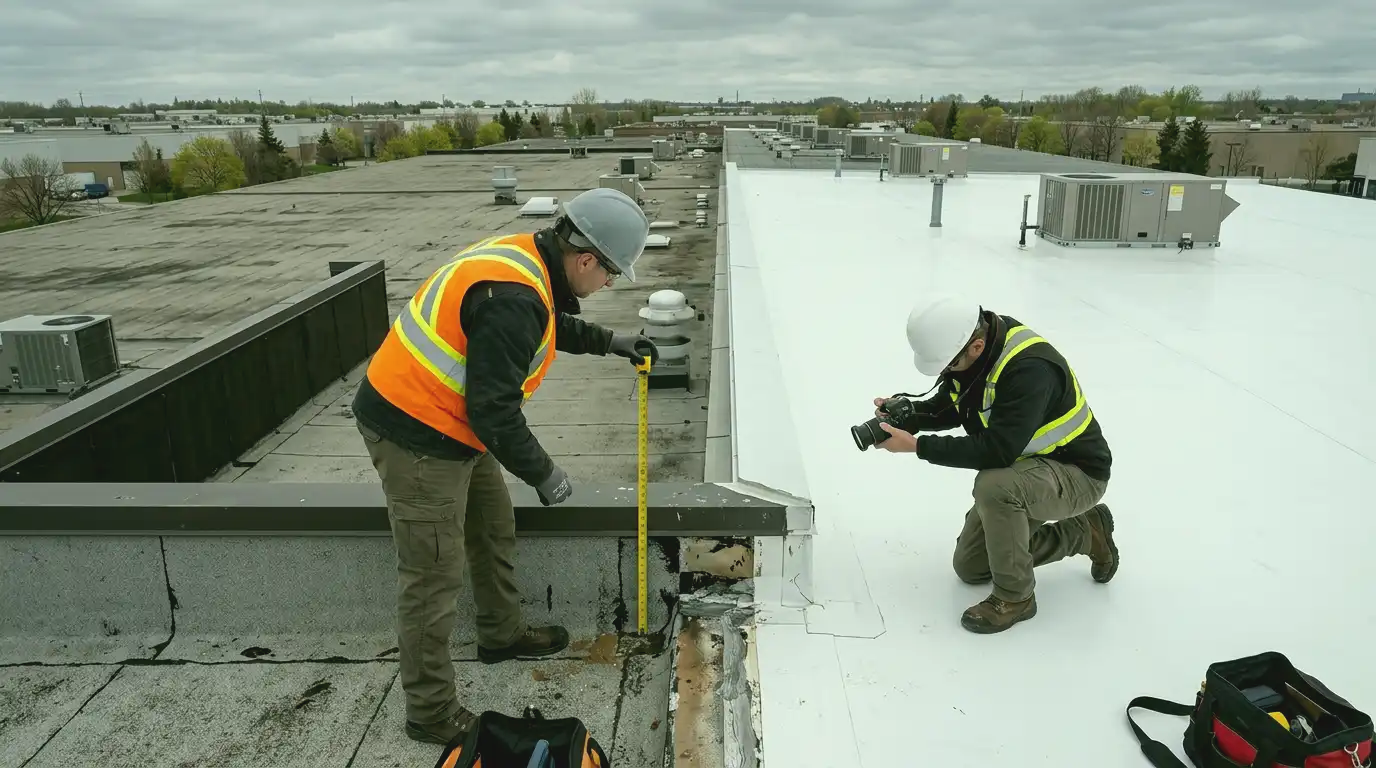
Three Brampton Roof Decisions to Clarify Early
Brampton commercial roofing decisions for industrial and logistics buildings can involve older assemblies, heavy rooftop equipment and continuous operations. Separate the roof history and access constraints before repair or replacement is priced.
Build a section-by-section roof history
Record roof ages, previous overlays, drains, repairs and equipment changes so older industrial roofs are not treated as one uniform assembly.
Commercial roof inspectionsPhase work around active logistics
Coordinate hoisting, dock activity, deliveries and daily watertight stopping points around the building operation rather than improvising after mobilization.
Commercial roof replacementInspect after rooftop service events
Frequent mechanical work can change curbs, penetrations and travel paths. Add post-trade checks to the normal maintenance record.
Commercial roof maintenanceBrampton Commercial Roofing Services
For low-slope roof construction and membrane planning, see our commercial flat roofing guide.
Inspecting Brampton Roofs of Every Age
Brampton's climate brings repeated freeze-thaw conditions, winter snow accumulation, warm summer heat, and heavy rain events that stress a flat roof in different ways across the year. Winter conditions concentrate snow and meltwater around drains, parapets, and low areas; summer heat expands membranes and accelerates wear at seams and flashings; repeated seasonal movement can open details that were only marginally compromised to begin with. A diagnostic approach that isolates the correct roof section, accounts for the building's construction era, and distinguishes a single-system failure from accumulated multi-generation problems produces far more reliable results than a general visual survey.
Separate the Drainage System from the Membrane Before Assuming Either Has Failed
On a large Brampton distribution centre or industrial roof, ponding water often indicates a blocked or undersized drain rather than a membrane failure. Before attributing a leak to the membrane, confirm that each drain and overflow is clear and functional. A drain operating at a fraction of its capacity during a heavy rain event can hold water at membrane seams long enough to exploit a detail that would otherwise stay dry.
On Older Bramalea Buildings, Investigate the Substrate Before Repair
A Bramalea-area industrial building with a history of multiple re-roofing generations may have wet or degraded insulation below the visible membrane surface. A repair that seals the top layer without addressing moisture already in the assembly will continue to fail. Moisture scanning or core sampling before finalizing scope helps avoid repairs that do not last and replacement recommendations made without accurate substrate information.
Track Leak Locations Against HVAC Service Records on High-Equipment Roofs
At Brampton pharmaceutical, food processing, and automotive facilities with dense rooftop mechanical installations, interior leak locations should be cross-referenced against recent mechanical service visits. Rooftop trades working on refrigeration, HVAC, or exhaust systems regularly disturb flashings, step on membranes, and leave penetrations unsealed. A repair call that starts by reviewing who accessed the roof in the previous 90 days is often resolved faster than one that begins at the leak stain on the ceiling.
Matching Roof System to Building Type in a Market This Diverse
TPO and PVC dominate new industrial construction in Brampton because they are heat-weldable, reflective, and perform well on large mechanically fastened fields. PVC carries an advantage where chemical exposure is a concern, grease-laden exhaust from food processing operations or chemical exposure from pharmaceutical rooftop equipment, because it resists those exposures better than TPO or EPDM over time. For older Brampton commercial buildings going through replacement, modified bitumen and hybrid assemblies remain practical choices that most Ontario contractors can properly detail and that tolerate Canada's seasonal temperature range reliably.
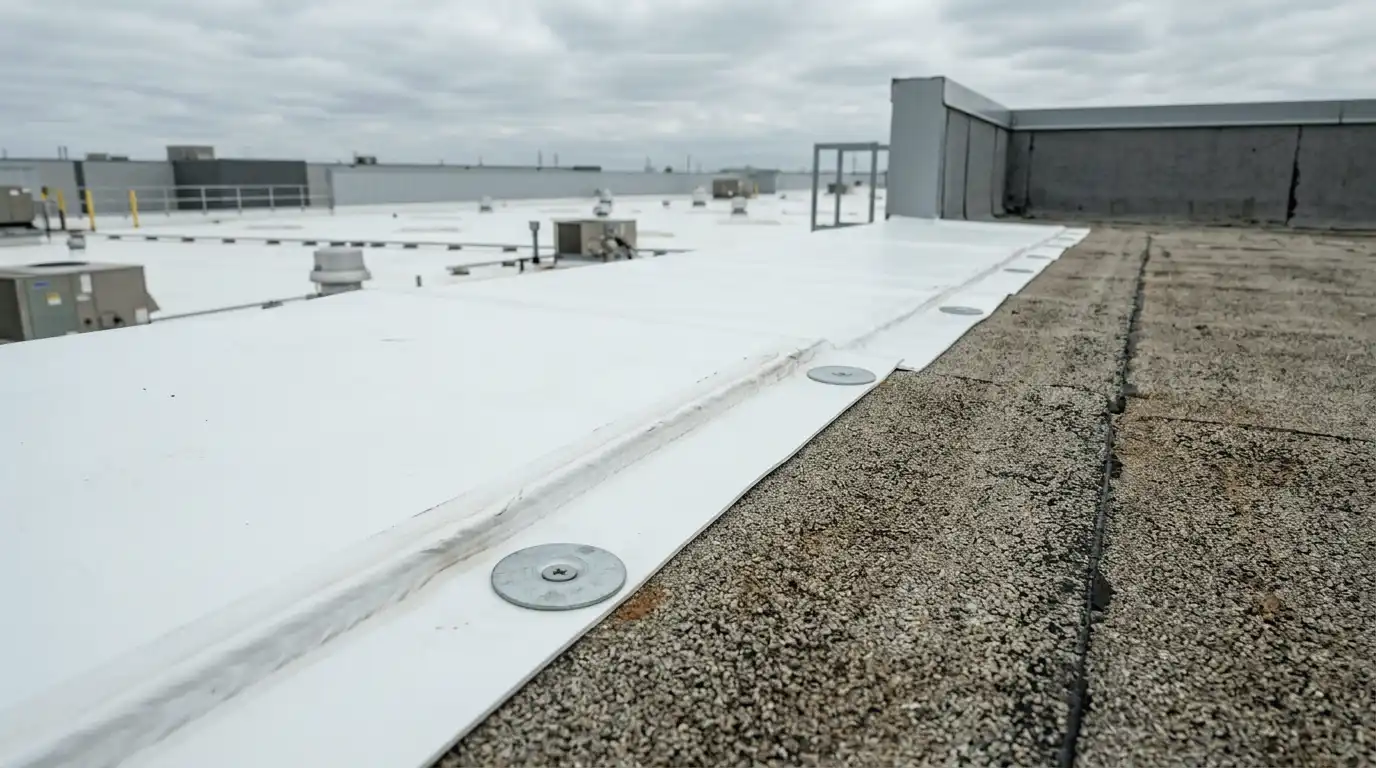
Attachment method deserves as much attention as membrane type. A fully adhered system on a Bramalea industrial building with an older lightweight deck behaves differently in wind uplift than a mechanically fastened system on a new concrete-deck distribution centre. Before selecting a system, an engineer or experienced specifier should confirm the deck type, the allowable fastener pull-out values, and whether the existing insulation, if being retained, is compatible with the proposed adhesive or fastening approach.
Commercial Roofing SystemsPlanning Roofing Work Around Daily Operations
Roof Work Around Active Brampton Logistics
Brampton's logistics facilities run around the clock. Staging a replacement project on a 300,000-square-foot distribution centre requires a pre-project plan that maps hoisting zones against dock activity, material delivery timing against inbound freight schedules, and daily work progress against operational areas that cannot be waterproofed on a fast track. Replacing a roof in phases is often the practical solution, completing sections sequentially so the building retains a watertight envelope at the end of each shift. On commercial plazas, the challenge is different: multiple tenants with different opening hours, shared walkways, and parking areas that cannot be blocked without tenants complaining formally. Both situations reward early coordination rather than on-site improvisation.
Roof Logs for Busy Industrial Properties
Given the density of rooftop equipment on Brampton's manufacturing and logistics buildings, unplanned roof maintenance is the more expensive path. A maintenance program that combines two formal inspections per year, spring and fall, with post-service checks after HVAC and mechanical trade visits gives property managers a running record of roof condition that makes budget conversations more accurate and emergency calls less frequent. For multi-tenant commercial plazas along Queen Street or Kennedy Road, coordinating maintenance across units, checking shared drains, verifying parapet coping conditions, and clearing overflow scuppers, prevents one tenant's drainage problem from becoming a water intrusion issue for the unit next door.
A Brampton owner with several buildings can keep one roof log per address so patterns in leaks and repairs are easier to see.
Roof maintenance planningRoofing Across Brampton Business Areas
Brampton owners can call on us for industrial, institutional, and commercial properties across Brampton, including the Bramalea industrial corridor, the 410 and 407 business parks, Gore Industrial areas, the Steeles Avenue and Kennedy Road commercial corridors, Queen Street plazas, Downtown Brampton, and the broader Peel Region. Wherever the property sits in Brampton, the next step starts with the roof condition and how the building needs to keep operating.
- Employment & commercial districts
- Bramalea industrial corridor · Highway 410 North Business Park · Gore Industrial North · Brampton 407 Corridor · Queen Street commercial corridor · Kennedy Road commercial corridor · Brampton Innovation District · Bram West industrial area · Airport Road industrial and commercial corridor · Steeles Avenue industrial and commercial corridor
- Neighbourhoods & nearby communities
- Downtown Brampton · Bramalea · Heart Lake · Mount Pleasant · Springdale · Bram West

Questions From Brampton Distribution and Plaza Owners
Why do older Bramalea industrial buildings often need a different approach than new Brampton distribution centres?
Bramalea's industrial buildings date largely from the 1960s and many have been re-roofed multiple times, leaving layers of older materials, original drain bodies that were not designed for modern membranes, and parapets that have been patched under different systems. New distribution centres, by contrast, typically have a single documented system, manufacturer warranty coverage still active, and relatively clean substrates. The older building needs thorough substrate investigation before any repair or replacement scope is set; the new building needs careful warranty navigation before anyone applies material.
What makes pharmaceutical and food processing roofs in Brampton harder to maintain?
Both building types generate chemical exposure on the roof surface, grease and steam from food processing exhausts, solvent vapour and chemical effluent from pharmaceutical operations, that degrades EPDM and some TPO formulations faster than a standard industrial roof would expect. These buildings also have very high rooftop equipment density, meaning more penetrations to maintain and more trade traffic than a typical warehouse. PVC membranes are generally preferred for their chemical resistance in these applications, and a maintenance plan that includes post-service penetration checks after every mechanical visit is worth establishing from the start.
How can a replacement project be staged on a Brampton distribution centre that operates 24 hours a day?
The roof is divided into zones sized to match the crew's daily production capacity, so the completed section at the end of each shift remains watertight without relying on temporary protection. Hoisting zones are planned around dock activity schedules, and material deliveries are timed to avoid peak inbound freight periods. The project plan should be reviewed and agreed with the facility manager before mobilization, not worked out on site during the first week.
A tenant in our Brampton commercial plaza has a leak, but the neighbouring units are dry. Is this a localized problem or a sign of something wider?
It depends on the drainage layout. If the affected unit sits in a low drainage basin or near a drain that serves multiple units, the problem may be as simple as a blocked overflow allowing water to back up to a seam that only the one tenant's ceiling reflects. It is also possible that a previous repair in that unit's section of the roof used incompatible material that has not bonded correctly. An inspection that maps the drainage layout and compares the condition of the affected section with adjacent sections will distinguish a localized issue from one that indicates broader system deterioration.
What should we confirm before a solar developer installs an array on our Brampton industrial roof?
Confirm the roof's current condition and estimated remaining service life. If the membrane needs replacement within ten years, plan either to replace it first or to negotiate a clear cost responsibility for removal and reinstallation of the array when the time comes. Also confirm the deck's structural capacity for ballasted racking under Brampton's winter snow load conditions, and verify that the proposed panel layout preserves unobstructed access to all roof drains and main flashing lines. A solar proposal that skips those steps is not complete.
How do I plan roof work across multiple Brampton buildings?
Start with a condition survey across the whole portfolio so the buildings can be ranked by urgency rather than handled in the order problems occur. Ask for a phased plan with budgets by year. Standardising on one or two proven assemblies where they suit each building can simplify maintenance and records.
Commercial Roofing Elsewhere in Peel and the North GTA
Start the Brampton Roof Conversation With the Building
Send us the Brampton address and what the building does. We will help you decide whether to repair, survey or plan a replacement.