
Aurora Commercial Roofing: Inspect Before You Replace
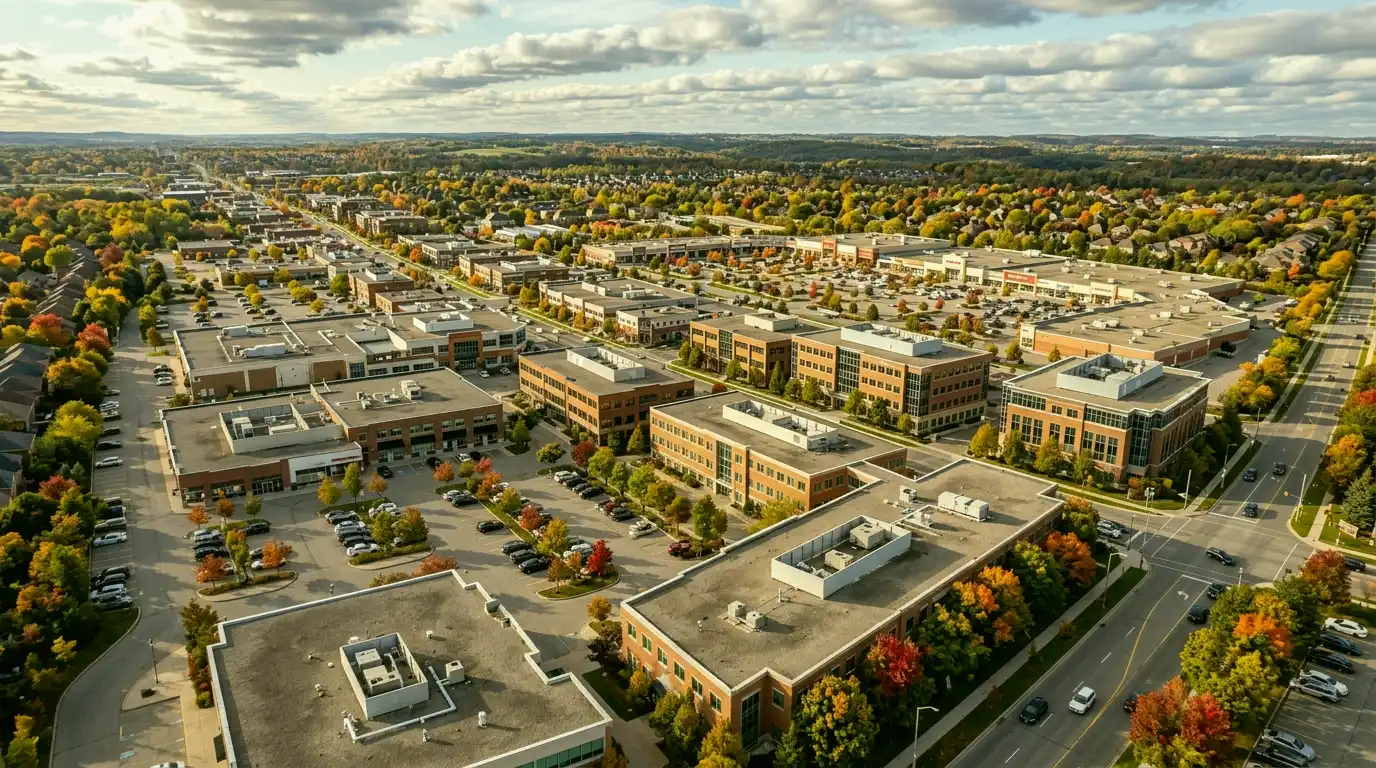
Aurora is home to Magna International's global headquarters and a business community that spans advanced manufacturing, auto-sector supply, food processing, information technology and life sciences. Older buildings on Industrial Parkway North and South carry decades of roof repairs; newer buildings at Addison Hall and Aurora Mills Business Park are entering their first maintenance cycles. Both environments have specific roofing needs that are not interchangeable.
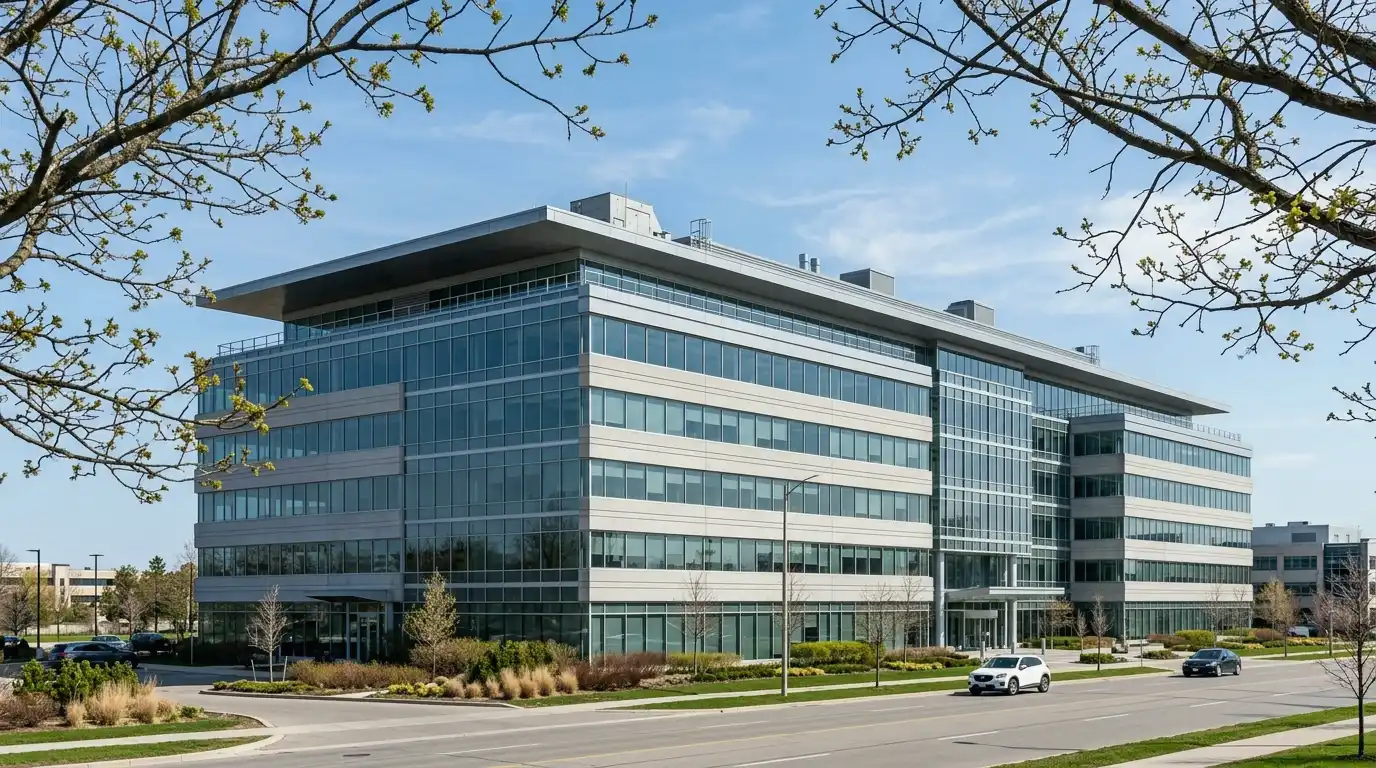
Aurora's Industrial Parkway and Leslie Street Roofs
Industrial Parkway North and South contain Aurora's most established commercial and industrial building stock, buildings that have been occupied, serviced and re-roofed multiple times since the 1980s and 1990s. Many carry the kind of mixed roof history that only shows itself fully during an inspection: two membrane types installed at different times, repairs that were logged but not mapped, drains that have been modified as mechanical equipment changed. For an advanced manufacturing or auto-sector tenant in one of these buildings, a roof that cannot be made reliably dry affects production and inventory, not just maintenance budgets.
The Leslie Street and St. John's Sideroad corridor is a different situation. New buildings at Aurora Mills Business Park, Addison Hall Business Park and other recent developments are entering their first service cycles with relatively clean roof histories, but they are also being occupied by a range of tenants that produce different rooftop equipment loads, different penetration patterns and different claims on the roof over time. A newer building is not automatically a problem-free roof, particularly once multiple tenants have contributed separate HVAC units, communications equipment and rooftop penetrations without coordinated roof oversight.
Local reference: Town of Aurora business and development profile, and YorkLink Aurora business park development reporting
Aurora Commercial Roofing Services
For low-slope roof construction and membrane planning, see our commercial flat roofing guide.
Start With a Roof Map, Not a Ceiling Stain
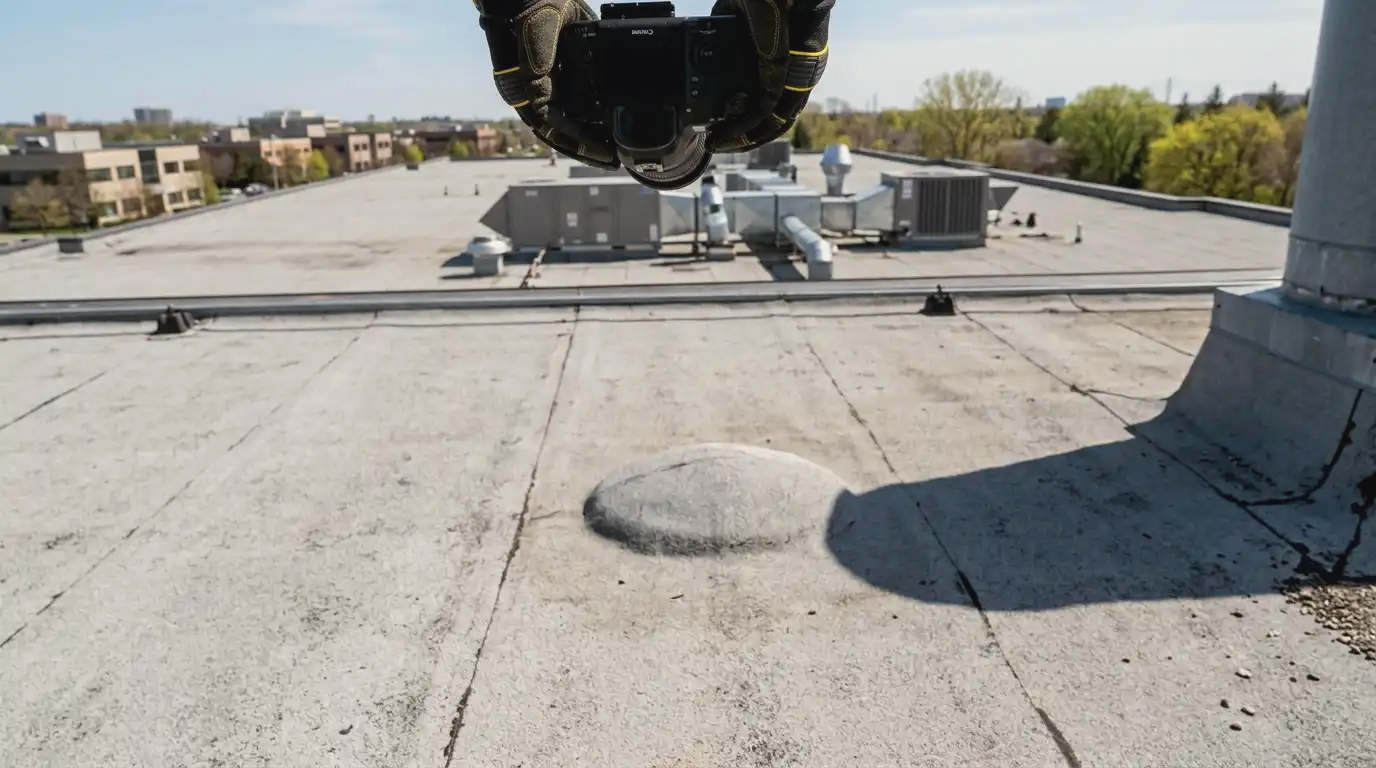
Aurora's multi-tenant commercial and industrial buildings generate leak reports from multiple sources, property managers, individual tenants, facility managers, and those reports are only useful if they are matched against the roof geometry above them. A leak reported in Suite 204 on a rainy Tuesday tells you the weather and the interior location; it does not tell you whether the source is above that suite, entering the structure at a parapet joint two units over, or tracking along a rooftop drain channel from a zone that belongs to a different section entirely. The investigation has to start on the roof, with an actual map of drainage paths, section boundaries, penetration locations and known repair history.
Wind off surrounding farmland exposes upwind perimeter details
Aurora sits at the edge of York Region's agricultural land, and prevailing winds that cross open fields without obstruction can stress parapet caps, edge metal and upwind curb flashings more than properties in more sheltered urban contexts. After any notable windstorm, the upwind face of a commercial or industrial building on Industrial Parkway or the new Leslie Street corridor is worth a perimeter check.
Map new tenant penetrations against the original roof plan
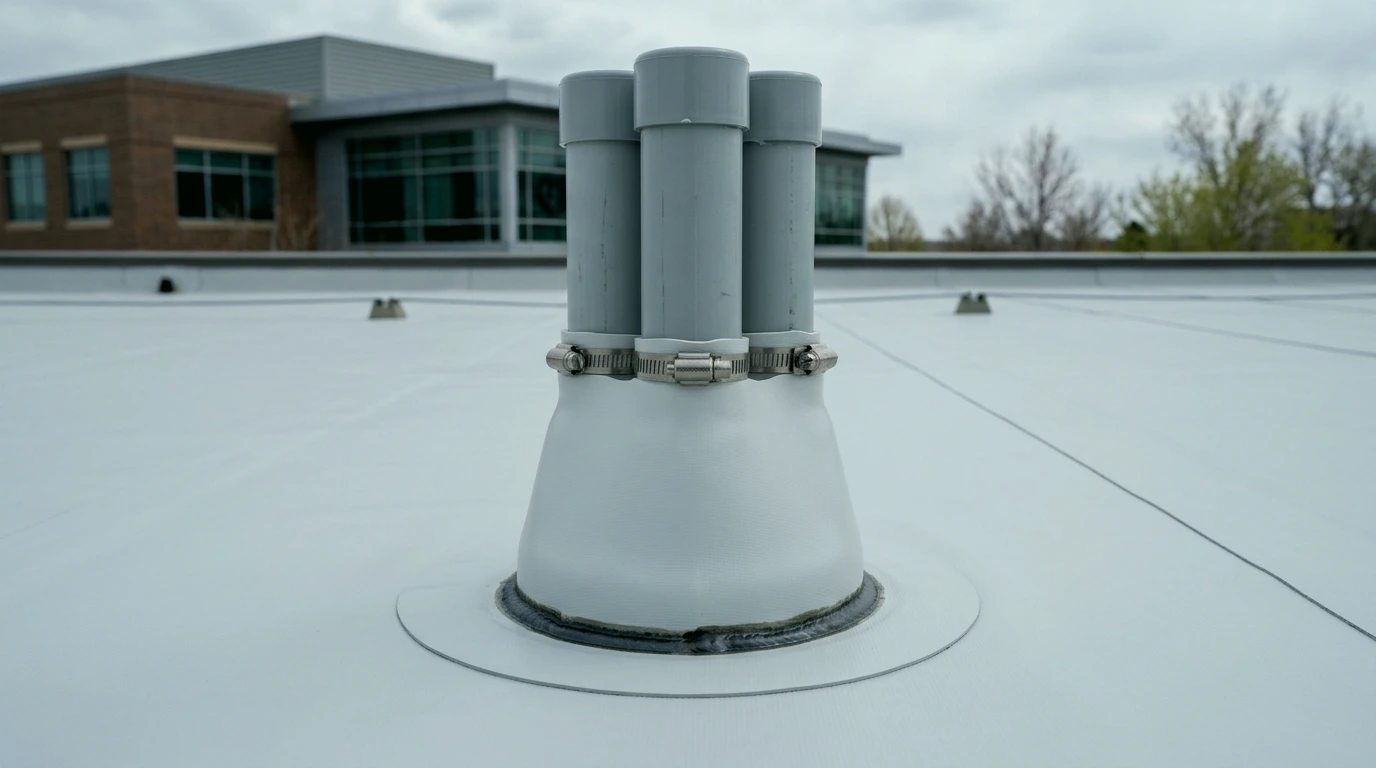
As Aurora business park buildings change tenants or add rooftop equipment, new penetrations accumulate. A curb flashing added outside the original roof contractor's scope may have been waterproofed to a lower standard or in a way that conflicts with the surrounding membrane assembly. Any unexplained new leak on a relatively new building should include a check of penetrations added after original construction.
Separate older and newer roof sections before defining the work scope
Those sections age differently. Identifying the boundaries before agreeing on a repair or replacement scope helps match the work to the actual condition of each roof section.
Choosing Roof Systems for Aurora Buildings
Aurora's commercial buildings support a wide range of industrial and office uses, and the roofing system comparison should reflect what is going on below. A building with Magna-tier auto-parts manufacturing or a medtech assembly operation benefits from a system with a strong seam track record and predictable maintenance requirements. A light industrial condominium in the new St. John's Sideroad corridor may be better served by a system that is easy to repair around multiple small penetrations as tenants fit out their units over time. PVC, TPO, EPDM, SBS modified bitumen and built-up assemblies all remain viable when the complete system, deck, insulation, attachment, drainage, perimeter detailing, is specified against the building rather than applied as a default.
The new commercial buildings on Leslie Street and St. John's Sideroad also raise a planning question worth addressing early: many of these developments are designed with rooftop solar potential in mind, and the membrane choice, insulation type and drainage layout should reflect that if solar is on the owner's or anchor tenant's horizon. On an older Industrial Parkway building being re-roofed, the same question applies: if solar investment is a possibility within the next decade, the replacement design should leave space for it rather than close off the roof in a way that makes a future array complicated.
Commercial Roofing SystemsPlanning Roofing Work Around Daily Operations
Scheduling Roof Work Around Active Tenants
The operational planning for commercial roof work in Aurora depends almost entirely on what is going on below. A Magna-tier auto-parts facility or medtech operation has specific requirements around acceptable working hours, vibration limits, interior protection for precision equipment and the consequences of an unplanned weather event above a sensitive production area. A multi-tenant Leslie Street industrial condominium has different constraints: coordinating separately with each unit holder, managing shared-access staging areas and ensuring that one tenant's roof work does not disrupt the unit next to them. In both cases, the work plan must address the building's operational reality before it addresses the roofing crew's preference for sequence.
A More Useful Roof Condition Log
Aurora commercial properties perform better on a maintenance program that uses section labels tied to the roof plan rather than informal descriptions that change with every service call. Record inspection dates by section, note drain conditions after significant rainfall events, photograph completed repairs, and add a roof check to the close-out procedure for any rooftop trade work. On a building with advanced manufacturing or tech tenants, that log also supports the argument that a recurring leak is, or is not, related to the tenant's own rooftop equipment activity. On a newer Leslie Street property with multiple condo unit owners, a shared roof log held by the property manager prevents individual tenants from conducting undocumented repairs that complicate the next inspection.
A written log of drain checks, penetration work and past repairs helps Aurora owners show a contractor how the roof has actually been treated.
Roof maintenance planningRoofing Across Aurora's Business Areas
In Aurora, we serve industrial and commercial properties along Industrial Parkway North and South, the Wellington Street East and Leslie Street corridors, the new business park developments around St. For each Aurora building, we base the recommendation on the roof that is there now rather than the neighbourhood name.
- Employment & commercial districts
- Industrial Parkway North and South · Leslie Street business corridor · Wellington Street East business corridor · St. John's Sideroad business park area · Aurora Gateway Business Park · Addison Hall Business Park · Aurora Mills Business Park
- Neighbourhoods & nearby communities
- Aurora Village · Yonge and Wellington · Aurora Promenade · Bayview Northeast · Aurora Gates
Aurora Commercial Roofing Questions for Owners and Tenants
What are the specific roofing risks for an advanced manufacturing or auto-parts facility in Aurora?
The primary risk is that a leak above a precision manufacturing area, a clean assembly environment or sensitive electronic equipment carries consequences beyond the repair cost. Rejected product, halted production, insurance complications and equipment damage are all realistic outcomes for a roof failure above the wrong part of an Aurora auto-sector or tech facility. That changes the practical calculus: these buildings benefit from earlier inspection intervals, higher thresholds for what constitutes acceptable membrane condition, and more conservative decisions about whether a repair or a section replacement is the right response. A contained leak that might be managed with a patch on a standard warehouse can be a capital decision on a facility where the production environment below it cannot tolerate intermittent water entry.
Is there a meaningful difference between roofing a newer Addison Hall or Aurora Mills building and an older Industrial Parkway property?
Yes, in both directions. A newer building has a cleaner roof history and a membrane that has not yet been stressed by the full range of York Region winters, but it may also be accumulating penetrations quickly as tenants fit out individual units with separate HVAC systems, communications equipment and process connections. That equipment can arrive without coordinated flashing detail, leaving gaps in the waterproofing that are not obvious until the first winter. An older Industrial Parkway building has a longer and more complex roof history but is also more likely to have a documented repair record and a clear picture of which sections are reliable. The inspection approach should match the building's age and history, not assume that newer automatically means problem-free.
How do York Region winters affect Aurora flat roofs differently than what a Toronto-based property manager might expect?
Aurora sits roughly 50 kilometres north of downtown Toronto, where winter conditions are reliably colder, windier and include a longer freeze season. Freeze-thaw cycles can be more pronounced because temperatures hold below zero longer before the lake-moderated warming that protects closer-in GTA properties. Wind off the surrounding agricultural land also means perimeter and edge details at Aurora commercial buildings can see sustained gusts that urban-infill Toronto properties rarely experience at the same intensity. Drain collars, parapet flashings and edge metal at an Aurora facility need to be specified and maintained with that wind and frost exposure in mind, not calibrated to a Toronto reference.
Should a commercial property manager in Aurora get a roof condition report before renewing or signing a major lease?
A roof condition report is a practical tool before any major lease commitment on an older Aurora commercial building. It identifies the current condition of each roof section, notes any wet insulation or drainage problems, documents recent repairs and gives a realistic picture of remaining service life. For a new tenant committing to a 5- or 10-year lease, understanding whether the roof is likely to need replacement in year three is directly relevant to the lease terms. For a landlord, it provides a documented baseline that separates existing conditions from tenant-caused damage if the question ever arises. The report does not guarantee future performance, but it converts an unknown into a managed item.
Can rooftop solar and rooftop HVAC units coexist on the same Aurora commercial roof?
They can, but the layout has to be planned with both in mind from the start. Solar arrays on a commercial roof with dense HVAC need clear access routes to every mechanical unit, for seasonal service, refrigerant changes and emergency repairs, that do not require dismounting panels to reach. Drains and overflow scuppers also need to remain accessible and unobstructed under and beside the array. The optimal approach is to map the HVAC layout, drainage geometry and roof service routes first, then design the array around those constraints rather than requesting access accommodations after the array is already engineered. On an older Industrial Parkway building, that process should also include a roof condition assessment, because adding solar to a membrane that will need replacement within the array's service life creates a costly sequencing problem.
When does it make sense to replace rather than keep repairing an Aurora industrial roof?
Consider replacement when repairs are recurring in different places, when moisture survey results show wet insulation across large areas, or when seams and flashings are failing at the end of their service life. If leaks trace back to a few identifiable details, a repair program can still be sound. A written comparison of both paths gives you a defensible budget decision.
Commercial Roofing Elsewhere in York Region
Tell Us What Is Happening on the Aurora Roof
Give us the Aurora property address and a short description of the problem. We will help you decide whether it is a targeted repair, an inspection or a bigger conversation about roof life.