
Newmarket Commercial Roofing for Busy Properties
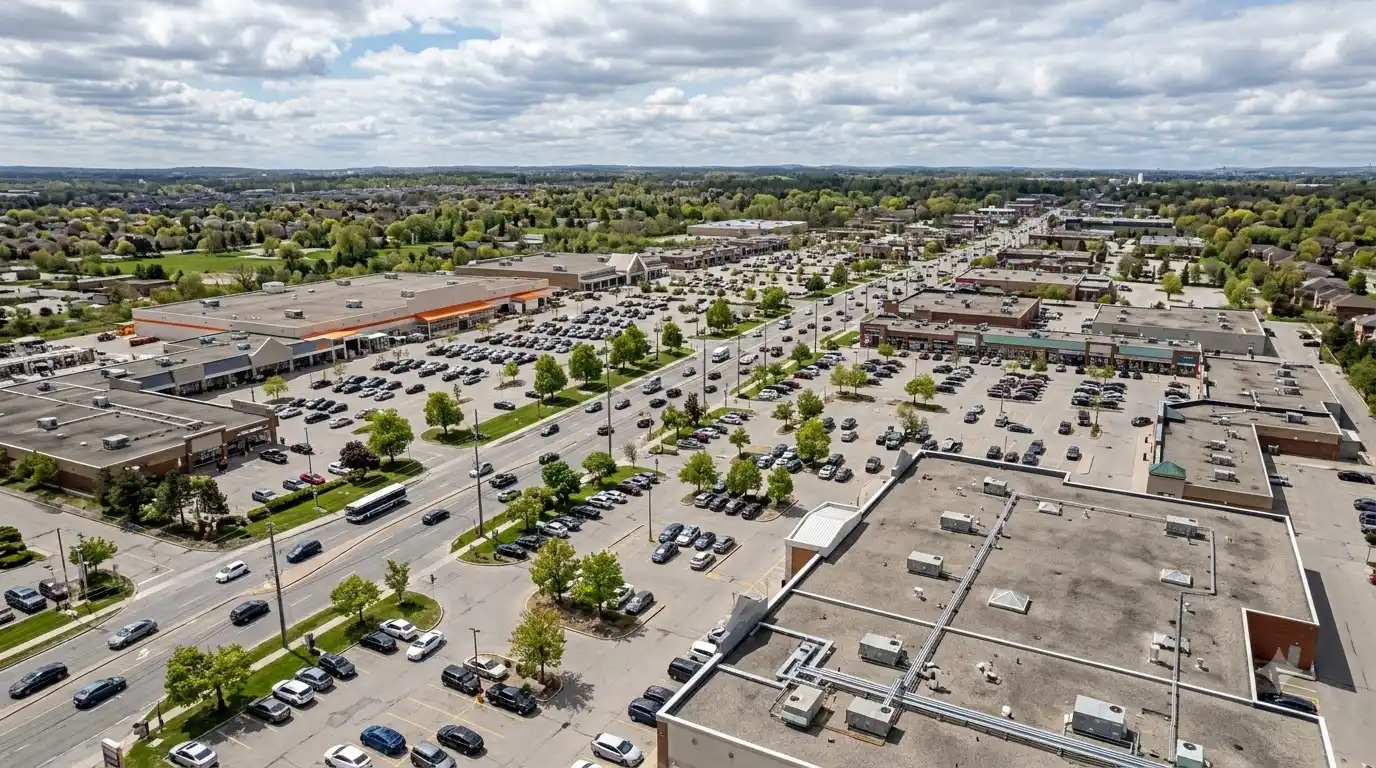
Newmarket's industrial land is almost entirely built out. The Town's three primary clusters, Harry Walker Parkway South, Pony Drive and the Mulock-Yonge corridor, pack manufacturing tenants, business-park units and logistics operations into a compact footprint, with Southlake Health on Davis Drive adding a major institutional presence.

Newmarket Business-Park Roof Conditions
Because Newmarket's industrial land inventory is largely occupied, the building stock on Harry Walker Parkway and Pony Drive ranges from newer multi-unit condos to older industrial and commercial properties that have accumulated layers of tenants, equipment and roof repairs. A single building can carry different roof generations across additions, with seams from two or three different contractors showing up in the same investigation. The Yonge-Davis growth area adds office, retail and mixed commercial properties where parapet conditions, wall interfaces and tight street-facing access change the diagnostic approach entirely.
The useful starting point for any Newmarket roof is knowing which section belongs to which roof generation. A newer 2,000-square-foot condo unit on Harry Walker has a clean membrane but vulnerable perimeter and curb details from the original build; an older Pony Drive building may have an older multi-ply roof under a cap sheet added by a previous tenant. On the healthcare and office side of Davis Drive, the relevant question is not just where the water entered but whether air intakes, mechanical rooms and sensitive interiors constrain how and when investigation work can happen.
Local reference: Town of Newmarket employment lands study and business-location information

Newmarket Commercial Roofing Services
For low-slope roof construction and membrane planning, see our commercial flat roofing guide.
Map Roof Ages, Drains and Recent Tenant Work
Start with the interior symptom and the weather that produced it, then identify which roof section and drain basin correspond to that interior location. On multi-tenant business-park buildings, ask whether another unit's HVAC contractor, electrical subcontractor or telecom crew recently accessed the shared roof. On older single-tenant buildings, check whether previous repairs closed or rerouted drain paths without updating the roof plan. On medical and office properties near Davis Drive, test every assumption about water origin before opening the roof in a way that disrupts the building.
Harry Walker multi-unit roofs
Map tenant boundaries, shared drainage basins and curb locations so a leak in one unit can be traced without disturbing an adjacent occupant's interior.
Pony Drive older stock
Identify roof generations, previous cap sheets and drain modifications before assuming the current surface reflects the actual drainage path.
Davis Drive institutional
Coordinate investigation timing with air-intake locations, clinical hours and emergency routes before opening any membrane above sensitive interiors.
Roof Systems for Newmarket Properties
In Newmarket's business parks, one roof often covers several tenants, so the system has to be practical to maintain as well as watertight. The variables that matter are deck condition and type, insulation and vapour control, attachment method, drainage layout, rooftop traffic and the sensitivity of the interior. A multi-tenant business-park unit with light mechanical equipment has different detailing priorities from a healthcare building with dense rooftop HVAC, multiple air intakes and a 24-hour operational requirement.

Replacement is also the moment to remove abandoned penetrations, rebuild drain sumps that have settled or been modified, and simplify a curb layout that has become tangled through successive tenant turnovers. If rooftop solar is planned for any Newmarket business-park roof, coordinate module layout, structural review and drainage access before finalizing the membrane specification, correcting those elements after modules are fixed in place is consistently more expensive than addressing them as part of the original replacement scope.
Commercial Roofing SystemsPlanning Roofing Work Around Daily Operations
Roof Work Around Shared Access and Occupancy
Harry Walker Parkway and Pony Drive units often share access roads and parking with adjacent tenants who need uninterrupted truck and customer access. Define hoisting zones, material staging, debris removal and daily watertight limits before mobilization, and confirm those plans with the property manager and any adjacent tenants who might be affected. On Davis Drive and Yonge-area medical and retail properties, add pedestrian protection, air-intake screening and coordination with building management around delivery windows and sensitive clinical hours.
Track Changes on Multi-Tenant Roofs
For business-park properties where lease turnovers bring new mechanical, electrical and telecom contractors through regularly, the inspection program needs a trigger beyond the calendar. A post-tenant-improvement check, covering the new curb or penetration, the travel path used to reach it and any drain obstructions, should happen before the area is signed off. Photograph from repeatable positions so a property manager can compare conditions across multiple inspections without relying on written notes alone. On healthcare and office properties, also inspect after HVAC servicing and any significant rooftop maintenance by other trades.
Newmarket owners can log tenant reports and rooftop service visits together to find where problems begin.
Roof maintenance planningServing Newmarket Commercial Districts
Newmarket roof work takes in properties around Harry Walker Parkway South, Pony Drive, the Mulock-Yonge corridor, Davis Drive and Downtown Newmarket. Roof size, drainage, equipment and access vary across Newmarket, so the work is planned around the individual property.
- Employment & commercial districts
- Harry Walker Parkway South business park · Pony Drive industrial area · Mulock-Yonge industrial corridor · Harry Walker Parkway industrial area
- Neighbourhoods & nearby communities
- Downtown Newmarket · Yonge-Davis corridor
Newmarket Roof Questions From Multi-Tenant and Healthcare Owners
Can shared roofs on Newmarket business-park condos be repaired without involving every unit owner?
It depends on the condominium declaration and what portion of the roof the defect falls in. Common element roofing is typically the corporation's responsibility, while curbs or penetrations tied to a specific unit's mechanical equipment may sit differently in the declaration. Before committing to a repair scope, confirm who owns the affected detail and whether adjacent units need access or notice. Getting that clear before the crew arrives avoids disputes later about who authorizes work and who pays.
Why does a Newmarket industrial building on Harry Walker Parkway keep leaking even after several patches?
Repeated patching without a confirmed diagnosis is the most common reason. If the repair targets the nearest visible defect rather than tracing the full water path from interior symptom through drainage basin to entry point, it can miss the actual source entirely. A seam patch on the field membrane, for example, will not fix a failing drain connection that allows water to travel laterally before emerging inside. A useful diagnostic follows the water, not just the stain.
Should a Newmarket healthcare or medical office building stay open during commercial roof replacement?
Often it can, but the project must be planned around the building rather than the other way around. Identify air intakes and confirm product selection and work methods that will not affect indoor air quality. Map emergency routes, clinical areas and patient access before opening any membrane. On a facility like a medical office attached to a hospital campus, consider whether odour from adhesives or torching near occupied areas requires adjusted sequencing or working hours. The answers vary by system and building, so they belong in the project scope before the contract is signed.
What should a Newmarket property manager record when a commercial tenant installs new rooftop HVAC?
Record the curb dimensions and location on the roof plan, photograph the new detail and the travel route used by the mechanical crew, confirm that drains near the new curb were not blocked or rerouted, and check that any temporary openings were properly closed with compatible flashing. Update the roof plan and photographs the same day if possible. That record protects the owner when the next tenant improvement happens and provides a clear starting point if a leak appears near the new unit in the following season.
How should a Newmarket building with additions of different ages handle a replacement budget?
Assess each section separately for moisture, membrane condition, drainage performance and repair history, then look at whether transitions between sections can be detailed as durable phase lines. An older wing with saturated insulation and recurring leaks may be a replacement candidate while a newer addition remains serviceable for several more years. Replacing them together because they share a mailing address spends money unnecessarily; replacing only the failing section along a technically sound boundary is usually the more defensible decision.
How do I handle roof leaks when several Newmarket tenants share one roof?
Keep a shared log of which suite reported each leak and when. Ask a roofer to trace the source across the whole roof rather than patching beside each stain. Tell tenants what to report and who to contact so responses are consistent.
Send Us the Newmarket Building and the Roof Details
Many Newmarket business-park roofs sit over active tenants. Send the address and what is underneath, and we will help you plan around it.