
Woodstock Commercial Roofing for Transport and Industry
Woodstock occupies a manufacturing position that most Ontario cities its size do not. The Toyota Motor Manufacturing Canada West Plant on the city's east side is a 1.8-million-square-foot facility on a 1,000-acre site, assembling RAV4 vehicles and batteries for the North American market. That plant anchors an automotive supply chain that runs through the 401 and 403 corridors, supported by manufacturers, distributors and suppliers concentrated around Pattullo Avenue, Commerce Way and the broader east Woodstock industrial area.
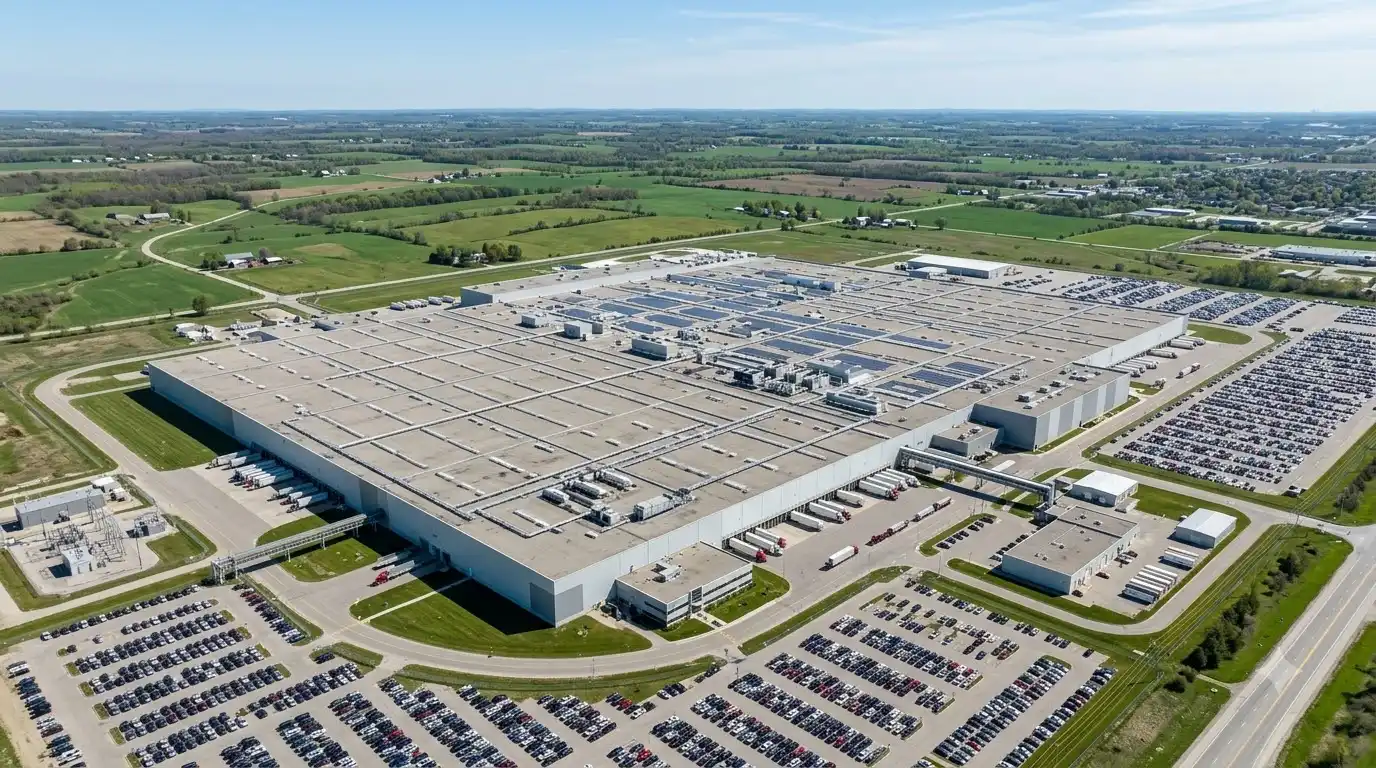
Woodstock Roof Decisions Should Follow the Building's History and the Operation's Tolerance for Disruption
Automotive-sector facilities in Woodstock operate on tight production schedules. A water event that reaches an assembly area, an electrical room or a parts-staging zone can disrupt operations well beyond the building itself. A roofer who does not understand the space below the membrane is not equipped to sequence a project responsibly on those properties. At the same time, older commercial buildings on Dundas Street and Norwich Avenue carry decades of decisions made by different owners, and understanding the current roof requires mapping those layers before making any recommendation.
For manufacturing and distribution buildings near Pattullo Avenue and Commerce Way, the starting point is a roof map tied to structural bays, drainage basins, construction eras and the production or inventory areas below each section. Record process exhaust and make-up air equipment positions, expansion joints, drains and access points. For older downtown and mixed-use commercial properties, map roof additions, level changes, parapet conditions and repair history before drawing any conclusions. In both cases, the map becomes the basis for every subsequent inspection, repair and replacement decision.
Local reference: City of Woodstock economic development and industrial expansion information
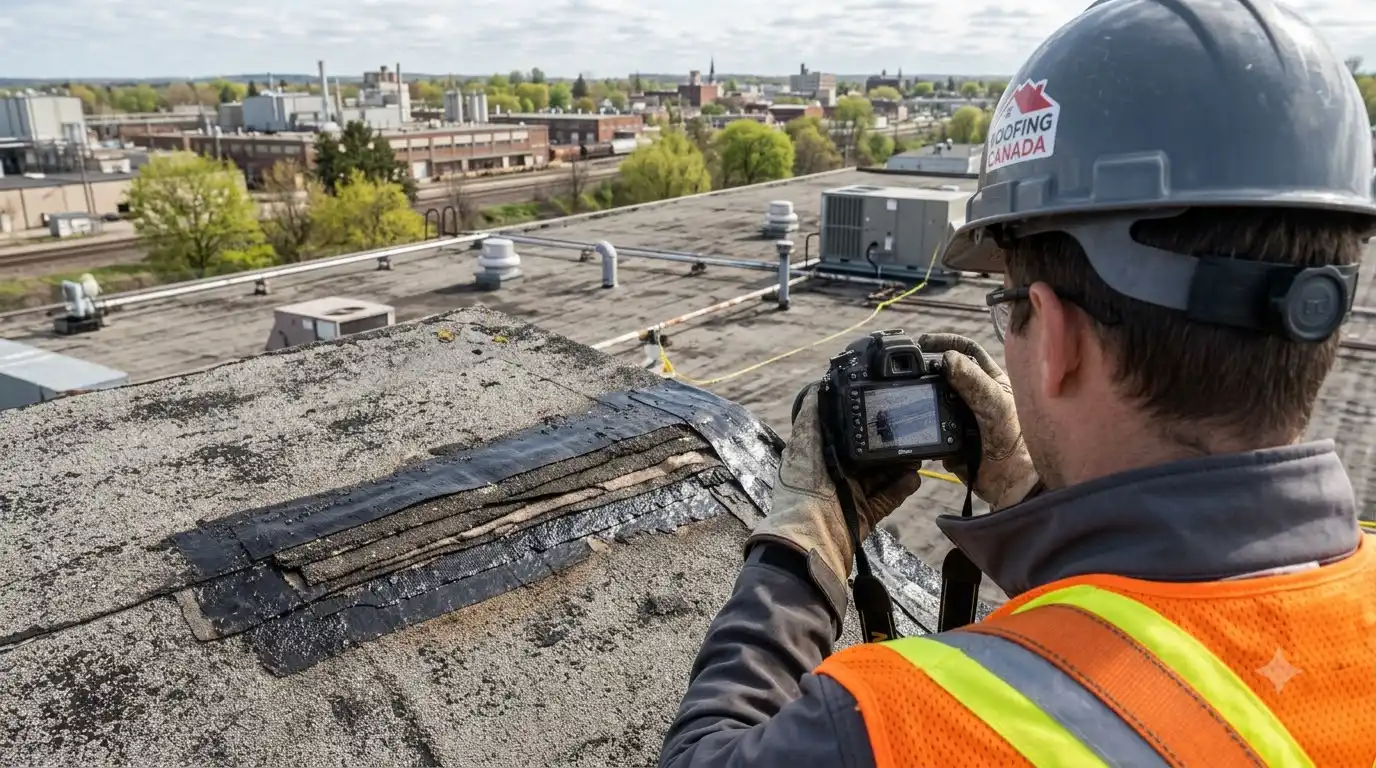
Woodstock Commercial Roofing Services
For low-slope roof construction and membrane planning, see our commercial flat roofing guide.
Woodstock Leak Investigation Should Connect the Interior Location to the Roof Drainage Zone Directly Above It
A leak in a Woodstock manufacturing facility can travel inside the deck and insulation across multiple structural bays before appearing at floor level. Record the bay number, the production or storage area involved and the preceding weather, then map that location to the contributing drainage zone on the roof. Inspect drains, seams, curbs, expansion joints and penetrations across that zone. On older buildings with multiple additions, check the transition joints between roof generations carefully, those transitions can be the weakest detail on the entire building while appearing unremarkable from above. When isolated repairs are not resolving a recurring problem, moisture testing across the suspect zone can define the real scope before another patch is applied.
Pattullo Avenue manufacturing roofs
Link leak symptoms to structural bays and production zones so investigations can proceed without disrupting active plant operations.
401/403 distribution and logistics properties
Map broad warehouse drainage basins and inspect high-use equipment routes before attributing a recurring leak to general membrane deterioration.
Mixed-vintage Woodstock commercial buildings
Treat each addition and roof generation as a separate investigation area so sections that are performing well are not condemned alongside those that are not.
Choose Woodstock Roof Assemblies for Manufacturing Exposure, Long Drainage Runs and Future Expansion
Woodstock's automotive supply buildings change layouts often, so roof planning must allow for equipment moves. Manufacturing buildings bring additional considerations: process exhaust, mechanical vibration, regular trade access and the possibility of future expansion or rooftop solar. Distribution and logistics roofs are often very large with long drainage runs and extensive perimeters where drain-sump geometry and fastening patterns matter more than the membrane choice alone.
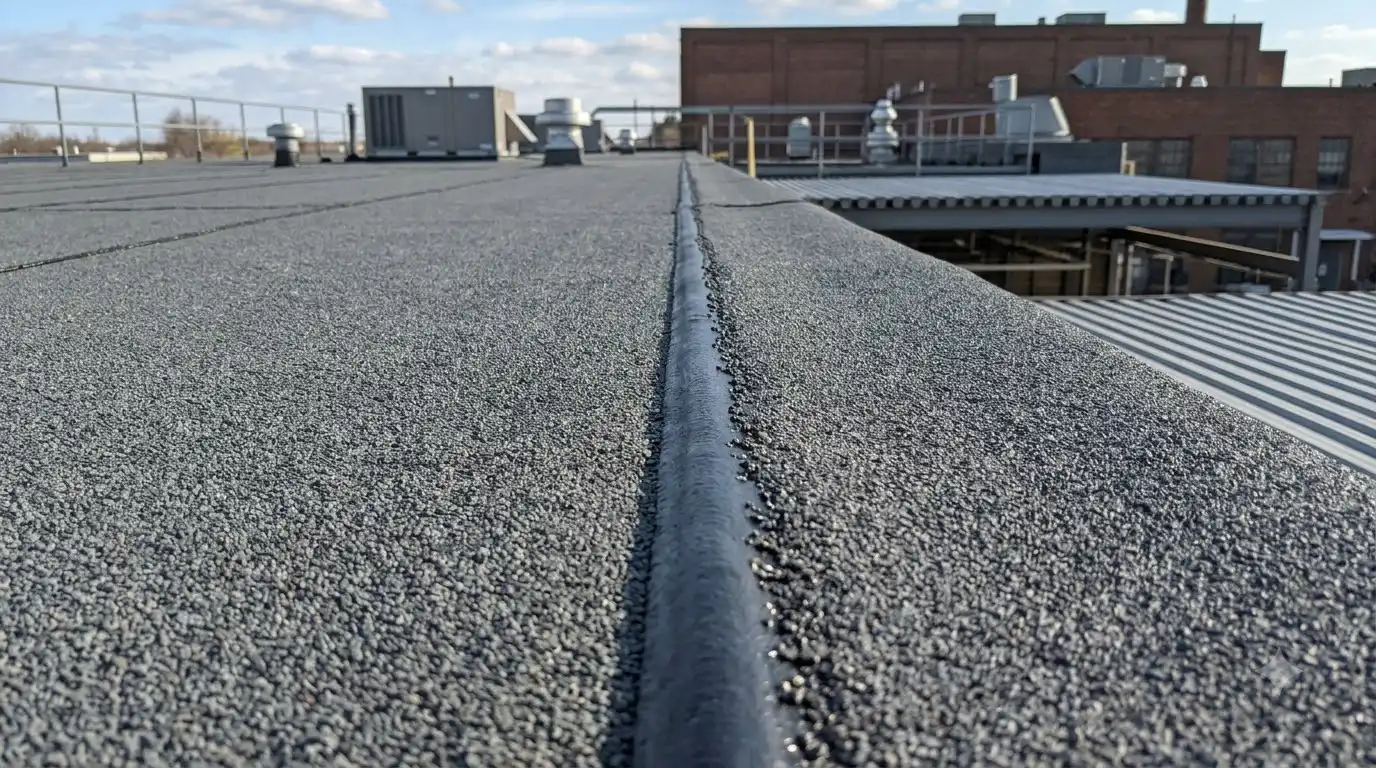
Reroofing a large Woodstock industrial building is also an opportunity to prepare for what comes next. Remove abandoned penetrations, improve documented low areas, create logical service routes and consider where future HVAC replacements or expansion additions would meet the new roof. If solar is under consideration, coordinate the array area with roof-replacement boundaries before the array design is finalized. A close-out package that identifies section boundaries, drain locations and installed systems is the difference between a property that is easy to manage long-term and one that its next owner must reconstruct from scratch.
Commercial Roofing SystemsPlanning Roofing Work Around Daily Operations
Sequence Woodstock Manufacturing Reroofing Around Production, Shift Changes and Active Freight Traffic
Woodstock's mix of automotive supply-chain plants and large-format distribution buildings means a reroofing project has to work around two different operating rhythms. On a supply-chain plant, the roofing schedule follows the production calendar, and the contractor needs shift schedules, planned shutdown windows and the locations of production-sensitive equipment mapped before any membrane is opened. On a distribution building along the Highway 401 corridor, the constraint is usually trailer traffic and dock scheduling rather than a fixed production line: yard circulation, trailer staging and peak shipping windows need to be understood before work begins, and daily tear-off limits should follow when the yard is busiest rather than a generic crew-capacity estimate. Either way, access routes, crane placement and weather contingencies should be agreed with the operations team in writing before mobilization, not worked out once material is already on the roof.
Woodstock Industrial Roof Maintenance Should Support Manufacturing Reliability and Long-Term Capital Planning
Spring and fall inspections set the baseline, with additional checks after severe weather events and after any outside contractor works on the roof. Clean drains and observe their performance, inspect expansion joints, check high-use service zones around equipment and revisit documented repair locations. Use the same roof-section names each time. For large manufacturing properties, compare annual service frequency and moisture findings by section so that a section approaching the end of reliable service is recognized before it fails rather than after. Consistent maintenance records also make the case for phased capital budgeting far more credible than a reactive proposal triggered by a major leak.
Supply-chain and line changes at a Woodstock plant sometimes reshuffle rooftop equipment; log them beside any new leaks.
Roof maintenance planningPattullo Avenue Industrial Park to Commerce Way industrial area: Commercial Roofing Coverage in Woodstock
Our Woodstock coverage spans commercial and institutional properties across Woodstock, including Pattullo Avenue and east Woodstock industrial and commercial areas, Commerce Way businesses, the Norwich Avenue business corridor, Downtown Woodstock and commercial and industrial properties with access to Highways 401 and 403. For each Woodstock building, we base the recommendation on the roof that is there now rather than the neighbourhood name.
- Employment & commercial districts
- Pattullo Avenue Industrial Park · Commerce Way industrial area · Highway 401 and 403 industrial and commercial corridor · East Woodstock industrial area
- Neighbourhoods & nearby communities
- Downtown Woodstock · Norwich Avenue business corridor

Woodstock Roof Questions From Plant and Distribution Managers
How should a Woodstock automotive-sector building plan a roof replacement without disrupting production?
The sequence starts with a production map, not a roof plan. Identify the interior areas where a water event would be most costly, assembly areas, electrical rooms, parts-staging zones, and plan the reroofing sequence so those sections are addressed last, after the crew has worked through adjacent lower-consequence areas. Establish a daily tear-off limit tied to what can be closed before the next shift change or weather window. Coordinate with the shift supervisor as well as the facility manager. A reroofing project on an active manufacturing facility is a logistics problem as much as a roofing problem.
What should be inspected first on a Woodstock manufacturing building with multiple additions from different decades?
Start with the addition transitions, the joints where one construction era meets another. These are typically the most vulnerable details on a mixed-age manufacturing building. They may have been flashed differently each time an addition was built, they experience differential movement as each section expands and settles independently, and they are often the areas where repair attempts have accumulated without resolving the underlying movement condition. Once the transitions are assessed, evaluate each section separately rather than treating the entire complex as a single homogeneous roof.
Can a Woodstock distribution building near the 401 or 403 corridor be reroofed while freight operations continue?
Yes, with careful logistics planning. Before the project begins, map active dock locations, freight vehicle circulation routes, trailer staging areas, employee parking, emergency access and the areas needed for hoisting, debris and materials. Schedule roofing deliveries around the facility's peak freight periods. Establish daily opening limits and weather contingencies. The constraint on daily progress should come from the logistics plan rather than from how much the crew can physically accomplish. A facility that keeps freight moving through a reroofing project does so because both teams planned together, not because the contractor improvised around a set of surprises each morning.
Why does wet insulation recurring near the same Woodstock drain suggest a more complex problem than a simple cleaning?
If cleaning solved the problem, the wet insulation would not return after the next significant rain. Wet insulation recurring near the same drain indicates that water is reaching the insulation layer and staying there, which means the membrane or flashing at the drain is allowing water in, the drain geometry or sump is producing chronic ponding that migrates into the insulation edge, or the wet insulation itself is already conducting water away from the drain area. The investigation should include the membrane-to-drain transition, the sump geometry, the surrounding slope and an estimate of how far the moisture has spread, not just a decision to apply sealant and clean the outlet.
What roof records matter most when a Woodstock commercial or industrial property is being sold or refinanced?
The most useful records are ones that allow someone unfamiliar with the building to understand the roof without a site visit. These include: the age and system type of each roof section, warranty documents and their terms, a leak and repair history organized by location rather than by date alone, drainage drawings or photographs showing drain and overflow positions, documentation of significant rooftop equipment changes and any moisture testing results. For a multi-section manufacturing building, records that assess each section separately are far more useful than a single-sentence statement about the overall roof condition.
How should Woodstock automotive suppliers plan roof upgrades?
Link roof work to production planning and plan for equipment changes. Ask the roofer to coordinate rooftop equipment relocations. Keep records of completed work.
Commercial Roofing Across Oxford County and the 401/403 Corridor
Start With the Woodstock Roof and How the Plant Runs
Automotive-supply and downtown roofs in Woodstock have different needs. Send the address and what you see, and we will help plan.