
Burlington Commercial Roofing for Complex Properties
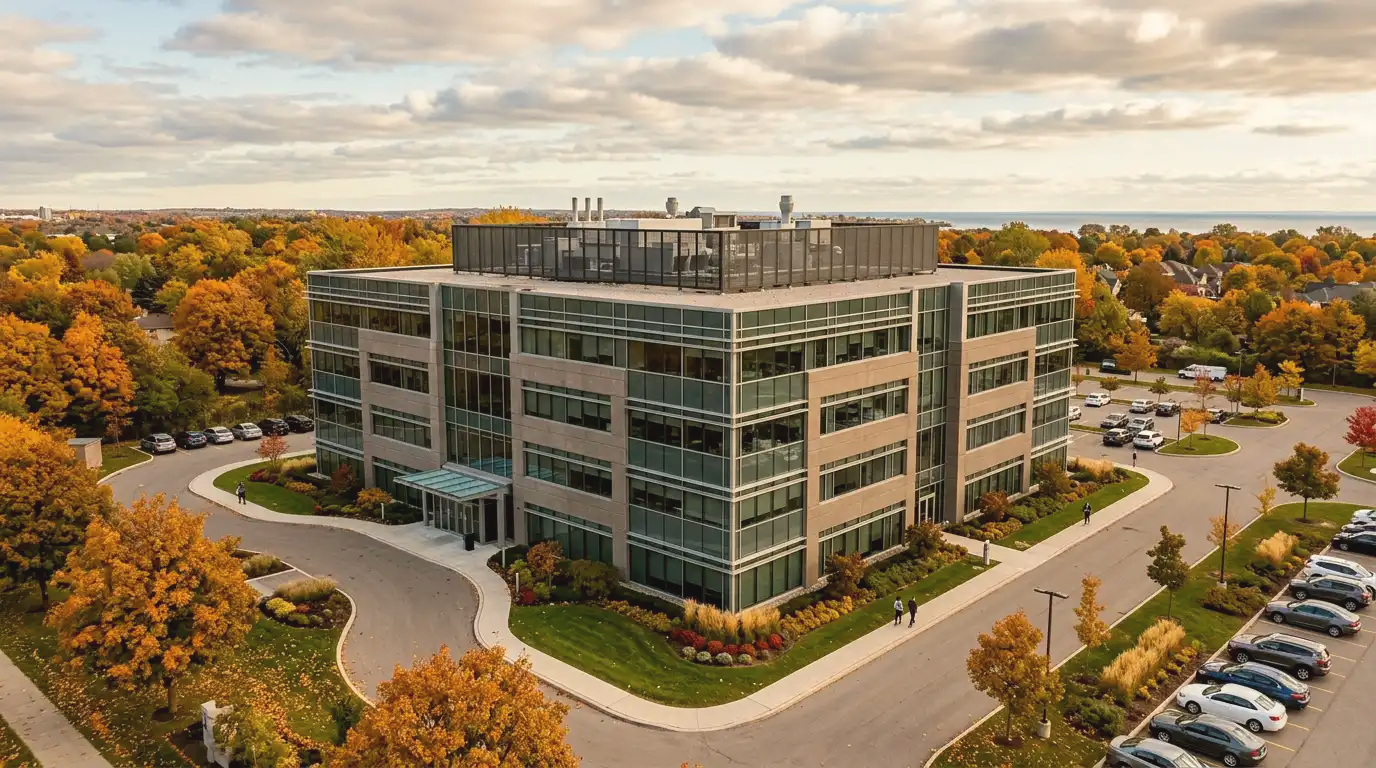
Burlington's commercial roofing market is defined by the QEW corridor. Between Highway 403 to the west and the Oakville boundary to the east, North Service Road, Harvester Road, and Laurentian Drive form an established industrial district where building ages range from 1970s heavy manufacturing to new Class A flex-industrial developments completed in the last few years.
Burlington's Industrial and Corporate Roofs
The buildings along North Service Road and Harvester Road span several decades of industrial development. Older heavy manufacturing facilities, some carrying 18 to 30-foot clear heights and enormous power draws, have rooftop mechanical and electrical equipment densities that produce more penetrations, more service traffic, and more ongoing flashing wear than a standard warehouse. When a building of that type has been re-roofed over an existing assembly without a substrate investigation, the condition beneath the current membrane is often quite different from what the surface suggests. Institutional acquisitions like CanFirst's three-building portfolio at 3100 and 3250 Harvester Road and 875 Laurentian Drive are now active in this corridor, and portfolio-level roof management, setting inspection schedules and capital planning across multiple buildings simultaneously, is a different discipline than single-property reactive maintenance.
The newer flex-industrial and corporate park buildings along Appleby Line, at Alton Corporate Centre, and near the Burlington and Appleby GO stations bring different considerations. These buildings were designed with current drainage standards and modern insulation assemblies, and their tenants often include professional services, technology firms, and food and beverage production operations with specific cleanliness and climate-control requirements. A Voortman Bakery production building or a tech firm's critical infrastructure environment has different expectations for roof performance and maintenance discipline than a general storage warehouse would.
Local reference: City of Burlington economic development, commercial investment and business parks
Burlington Commercial Roofing Services
For low-slope roof construction and membrane planning, see our commercial flat roofing guide.
Investigating Burlington Roof Leaks
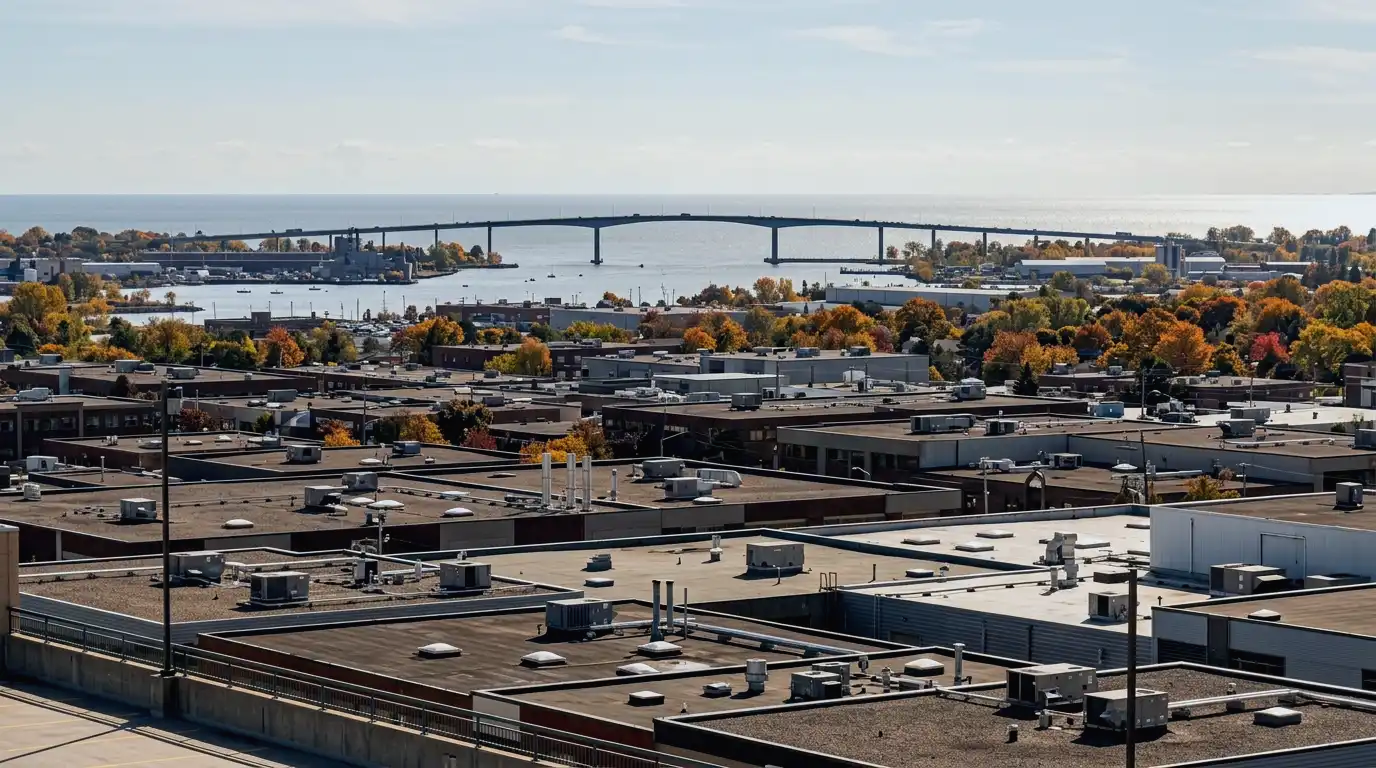
Burlington's QEW industrial corridor includes buildings with varying exposure to Lake Ontario winds and open transportation corridors. After a significant wind-driven rain or winter storm, perimeter metal, copings, parapet flashings and exposed wall transitions are sensible inspection priorities on buildings that face the prevailing weather. The useful evidence is the building's own leak history and exposure, not a blanket assumption that every QEW property experiences harsher conditions than an inland roof.
QEW Corridor Wind Exposure Tests Perimeter Details First
On Burlington industrial buildings directly adjacent to the QEW or North Service Road, lake-driven winds create lateral pressure on edge metal, perimeter flashings, and parapet cap flashings that can open marginal details over time. After any significant storm, a post-event check of these zones on older buildings in the Harvester Road and North Service Road corridor is worthwhile. A cap flashing that appears seated when viewed from below can be lifted enough at the wall termination to allow water entry during wind-driven rain events without triggering an obvious interior leak until the water has migrated well into the assembly.
On Heavy Manufacturing Buildings, Map Penetrations Before Inspecting
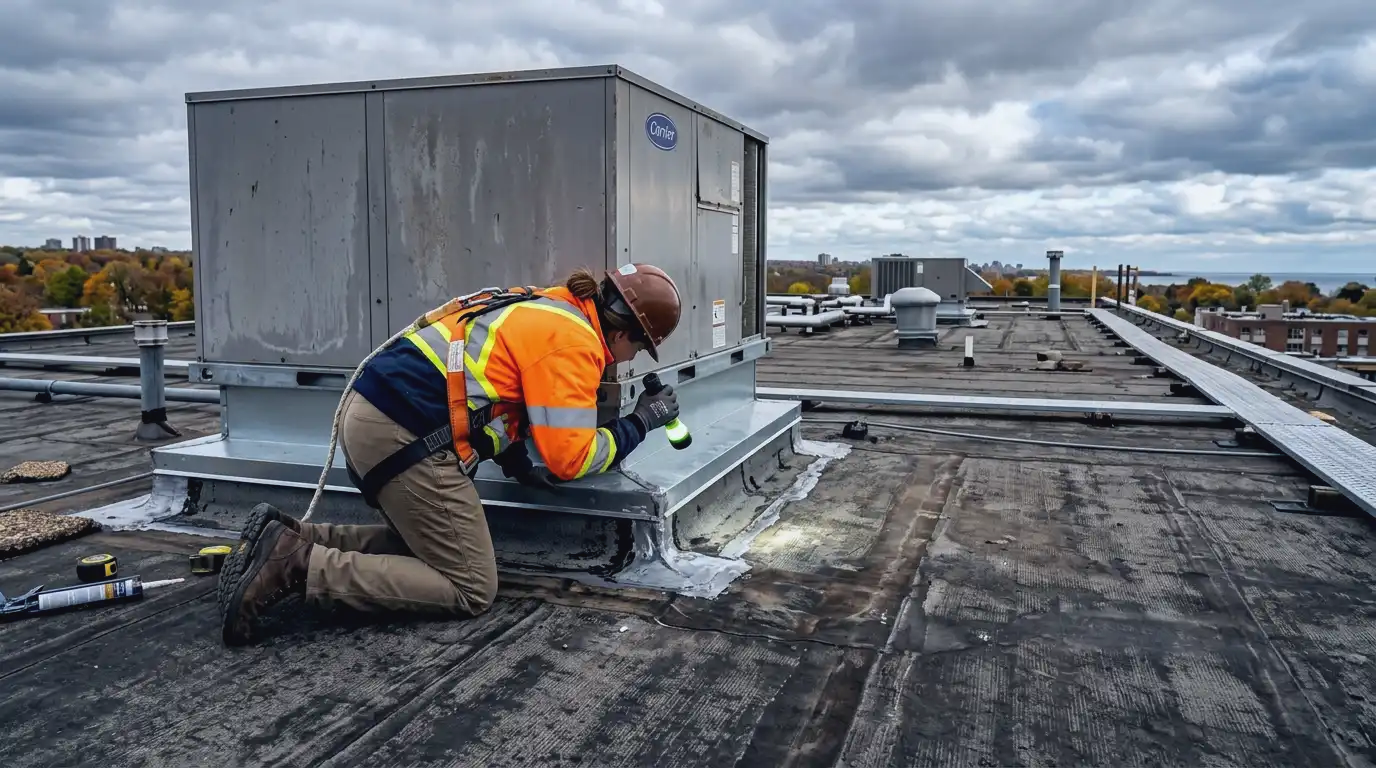
Burlington's heavy manufacturing buildings on North Service Road carry dense rooftop electrical, HVAC, and process equipment. Before inspecting one of these roofs, obtain the mechanical drawing set or a current as-built of rooftop equipment. Mapping each penetration against its curb flashing condition, and checking each against recent maintenance trade visits, is more productive than a general visual walk. The number of penetrations on a heavy manufacturing roof means that any visual scan misses details that a systematic review would catch.
Food Production Buildings Need Internal Environment Context
At Burlington food production facilities, including the Voortman Bakery operation on North Service Road, rooftop diagnostics should include an assessment of the internal environment's effect on the roof assembly. Heat, steam, and baking exhaust discharged through rooftop ventilation create a chemical and temperature exposure profile that can degrade some membrane types faster than exterior weather alone would predict. PVC membranes offer better resistance than EPDM or TPO to the grease and fat-bearing exhaust typical of baking operations.
Roof Systems for Burlington Properties
Newer Burlington industrial and Class A buildings commonly use modern single-ply systems such as TPO or PVC, but membrane thickness and attachment method should come from the project specification, deck type, wind design, occupancy and warranty requirements rather than a universal standard. Institutional owners and investors may also have their own minimum roofing criteria. On food-production properties, any confirmed grease, oil, cleaning-chemical or process exposure should be checked against the membrane manufacturer's compatibility guidance before a system is selected.

For older Burlington heavy manufacturing buildings undergoing full re-roofing, the substrate investigation that precedes system selection often determines the project scope more than the membrane choice does. A 1970s heavy manufacturing building may have a lightweight steel or poured concrete deck, each requiring different attachment methods and fastener specifications. Insulation compatibility, drain body replacement, and parapet flashing design all interact with the membrane selection. Getting the system specification right on a building of that type requires the same level of engineering consideration that was applied to the original structure, not a like-for-like patch with a more modern product.
Commercial Roofing SystemsPlanning Roofing Work Around Daily Operations
Managing Roof Work Around Occupied Sites
Burlington's industrial corridor properties are typically operating businesses with freight, employee, and visitor traffic that constrains staging options on site. On the Harvester Road and North Service Road corridors, material delivery and hoisting need to be planned around freight lanes and public road adjacency, the QEW is immediately to the south, and staging conflicts that spill into the service road create safety and access issues quickly. For corporate park properties near Burlington GO and Appleby GO stations, tenant-facing aesthetics during a re-roofing matter more than they would at a freight-only facility. Overhead protection, site cleanliness, and working hours that respect office tenant schedules are part of the contract scope, not afterthoughts.
Commercial Roof Maintenance in Burlington
Burlington's institutional property management culture, more prevalent here than in smaller Ontario markets, means that planned roof maintenance programs are increasingly the expectation rather than the exception. A twice-yearly inspection cadence, post-storm edge checks, and post-service penetration verification after HVAC and mechanical trade visits form the baseline for most well-managed Burlington industrial properties. For corporate park office and tech buildings, the maintenance record supports tenant retention by demonstrating building envelope management and reduces the liability exposure that comes with a deferred leak claim from a technology or professional services tenant whose operations were disrupted by a preventable roof failure.
In Burlington, a roof log that records heavy-equipment work and leak dates helps owners show where problems start.
Roof maintenance planningRoofing Across Burlington's Industrial Districts
Our Burlington reach covers industrial, institutional, and commercial properties across Burlington, including the North Service Road and Harvester Road QEW industrial corridor, Alton Corporate Centre, the Appleby and Walkers Line industrial areas, Downtown Burlington, and the broader Halton Region. Roof size, drainage, equipment and access vary across Burlington, so the work is planned around the individual property.
- Employment & commercial districts
- North Service Road QEW industrial corridor · Harvester Road and Laurentian Drive industrial district · Alton Corporate Centre · Walkers Line industrial area · Appleby Industrial Park · Downtown Burlington commercial · Harvester Road business corridor · North Service Road industrial and commercial corridor · Burloak industrial area · Palladium Prosperity Park (4301 Palladium Way)
- Neighbourhoods & nearby communities
- Downtown Burlington · Aldershot · Appleby · Alton Village · Millcroft
Burlington Commercial Roof Questions Answered
How does the QEW's Lake Ontario exposure affect flat roofs on Burlington industrial properties?
Some QEW and North Service Road buildings have open exposure to wind-driven weather from the lake side, so perimeter flashings, edge metal and wall transitions may deserve extra attention after major storms. The effect depends on the specific building orientation and surrounding shelter. Track which wind direction and weather conditions correspond with any leak, then inspect the exposed details on that face instead of assuming lake proximity alone determines performance.
We manage a multi-building industrial portfolio on Harvester Road. How do we approach roof capital planning across multiple buildings?
Treat the portfolio as a system rather than a set of individual problems. A portfolio-level roof assessment, inspecting all buildings in the same season and categorizing each by approximate roof age, membrane type, maintenance history, and substrate condition, produces a three-to-five-year capital forecast that allows you to budget accurately and plan projects in the off-season rather than responding to emergencies. It also surfaces patterns across buildings that individual reactive repairs miss, such as a membrane type that has consistently underperformed across the portfolio or a contractor whose work has generated repeat callbacks on multiple properties.
What makes a food production building like Voortman Bakery's Burlington facility different to roof than a standard industrial building?
A food-production roof can have more exhausts, condensate points, service traffic and process-related rooftop exposure than a general warehouse. The important step is to document what each exhaust actually carries and whether grease, oils, heat or cleaning chemicals reach the membrane. If they do, check the roofing manufacturer's chemical-compatibility guidance and detail the affected zones accordingly. No single membrane should be prescribed for the whole building solely because it is a bakery.
A Burlington tech company occupying industrial space complained about a roof leak that disrupted their server room. What should we as property managers have done differently?
The most effective prevention is a maintenance program that includes post-storm edge checks and post-service penetration verification, not just the minimum two annual formal inspections. Tech tenants running server rooms and sensitive equipment need a higher assurance of roof integrity than a general storage tenant does, and the lease terms for that space should reflect that expectation with a documented maintenance standard. If the leak traced to a service trade visit that disturbed a flashing without a follow-up check, that is the specific process gap to close: a post-service verification protocol that confirms no new penetrations were opened and left unsealed.
Is Burlington a good market for rooftop solar on industrial buildings?
Many Burlington industrial buildings have large, relatively open flat roofs that can be evaluated for solar. Suitability still depends on the individual property: remaining roof life, structural capacity, applicable wind and snow loading, shading, drainage and maintenance access all matter. If a roof is approaching planned replacement, coordinate the reroofing before or with the solar project so the array does not have to be removed shortly after installation.
What roof maintenance should a Burlington manufacturer budget for each year?
Plan for at least one scheduled inspection per year, drain and scupper cleaning, minor seam and flashing repairs and a review after any rooftop equipment work. Setting aside a modest maintenance amount avoids emergency calls and extends roof life. Keep invoices and reports together, since they support both warranty and capital planning.
Commercial Roofing Elsewhere in Halton and Around the Bay
Tell Us About the Burlington Roof and How the Building Runs
Send the Burlington address, the type of operation and a short description of the roof concern. We will help you decide the next step.